
What is Pilates? A beginner’s guide

When you think of Pilates, you probably picture controlled movements on a mat or Reformer machines in a studio. But there’s more to it than that. Pilates is built around breathing, movement control, core strength and body awareness. The aim isn’t simply to finish an exercise; it’s to move with greater awareness, balance and control.
That’s why describing Pilates as something people do just to become more flexible misses part of the picture. It can also be a useful addition for runners, cyclists, people who lift weights, desk workers and anyone who wants to move better. So what exactly is Pilates, what can it help with, and where should a beginner start?
What is Pilates?
Pilates is an exercise system developed by Joseph Hubertus Pilates in the early 20th century. He originally called his method Contrology. That name gives you a pretty good idea of the thinking behind it: moving with conscious control of your body, rather than simply going through the motions.
Today, people practise Pilates to work on areas such as:
- Core strength.
- Posture.
- Balance.
- Movement control.
- Flexibility.
It can be done on a mat or with equipment, particularly the Reformer. One reason Pilates has become so widespread is that it can be adapted to different levels. Someone who has never exercised before and a professional athlete can both apply the same basic principles at a level that suits them.
How did Pilates begin?
Joseph Pilates was born in Germany in 1883 and spent his life exploring physical training and different exercise systems. His approach developed from a combination of gymnastics, breathing practices, strength work and body control. Accounts of his work during the First World War describe him adding springs to beds to create resistance while working with injured people and those with limited mobility. These systems are said to have contributed to the later development of Pilates equipment.
After he moved to the United States in the 1920s, his method became especially popular among dancers. Today, Pilates reaches well beyond the dance world. It’s used in gyms, physiotherapy centres, individual training sessions and supplementary training for professional athletes.
What are the basic principles of Pilates?
One thing that sets Pilates apart from many other forms of exercise is its emphasis on movement quality over the number of repetitions. Rather than doing a movement quickly dozens of times, the preference is for fewer repetitions with better control. Six key principles are commonly associated with the classical Pilates approach.
Breathing
Breathing isn’t treated as separate from movement. The two work together, with the aim of maintaining a steady rhythm rather than holding your breath. Your instructor may remind you about breathing quite often, especially at the beginning. It might feel like a lot to think about in your first few classes, but the connection between breath and movement is an important part of Pilates.
Concentration
Pilates asks you to pay attention. You’re encouraged to notice how your body is positioned and which muscles you’re using. So the task isn’t just to complete a movement, but to stay aware of how you’re doing it.
Control
The movements are built around control rather than speed. The aim is to manage the movement from start to finish, rather than let momentum do the work. Don’t be surprised if your instructor asks you to slow down from time to time.
Centring
One word you’ll hear a lot in Pilates is core. This means more than just your abdominal muscles. The muscles around your abdomen, lower back and pelvis work together with those that stabilise your torso.
Flow
The aim is to move as smoothly as possible. Instead of treating each exercise as completely disconnected from the next, Pilates favours controlled transitions between movements.
Precision
This is one of the most distinctive aspects of Pilates. Simply finishing a movement isn’t enough; doing it in the right position and with control matters.
What’s the difference between Mat Pilates and Reformer Pilates?
If you’re thinking about starting Pilates, one of your first questions will probably be:
“Mat Pilates or Reformer?”
It’s often one of the first things other people ask when you tell them you’ve started, too. In reality, Mat Pilates and Reformer Pilates are different ways of practising the same system, rather than completely separate alternatives.
| Mat Pilates | Reformer Pilates | |
|---|---|---|
| Main equipment | Pilates mat | Reformer machine |
| Resistance | Body weight and small props | Spring system |
| Where you practise | At home or in a studio | Usually in a studio |
| Starting cost | Lower | Higher |
| Instructor guidance | Helpful | Particularly important at the beginning |
Mat Pilates
In Mat Pilates, your own body weight provides the main resistance. Equipment such as resistance bands, small balls or a Pilates ring can be added later. Because you can do it at home and need very little equipment, it’s one of the most accessible ways to start.
Reformer Pilates
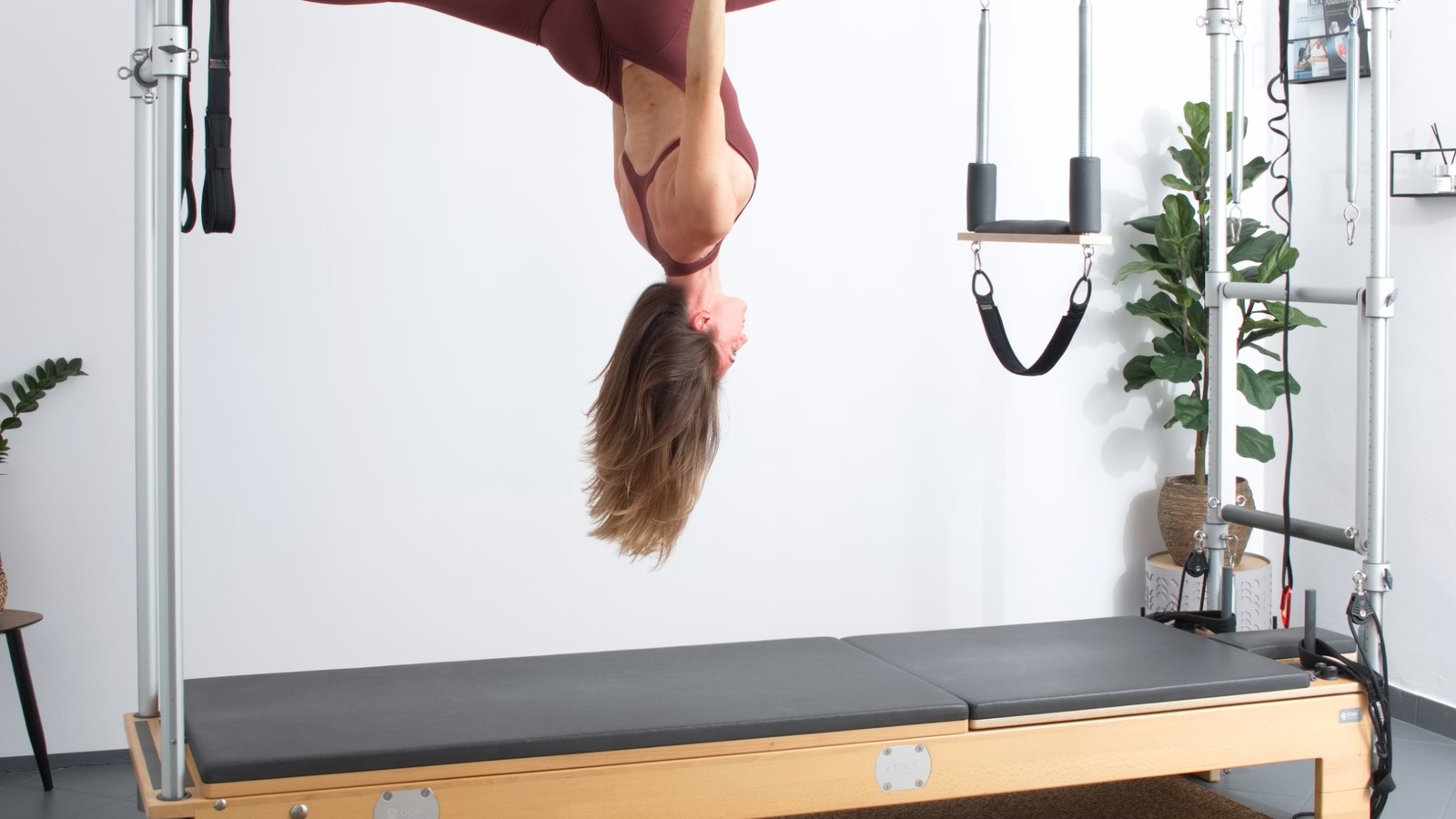
A Reformer is a Pilates machine with springs and a moving carriage. The spring resistance can make some exercises more challenging and provide support during others. So it isn’t accurate to describe Reformer Pilates simply as “the harder version of Mat Pilates”. That’s a common misconception. Both approaches can challenge and support movements in different ways.
What can Pilates help with?
Naturally, the benefits are one of the things people are most curious about. Pilates shouldn’t be presented as a method that solves every problem. But research suggests that regular practice may offer benefits in certain areas.
It may support core strength
Many exercises require you to keep your torso stable. That brings the muscles around your abdomen, lower back and pelvis into active use. This can make Pilates a useful addition for people who run, cycle or do strength training.
It may improve postural awareness
People who spend long hours at a desk often find their shoulders moving forwards or their pelvic position changing. Because Pilates repeatedly asks you to pay attention to the position of your spine, pelvis and shoulders, it may improve body awareness. It wouldn’t be right to make a blanket claim that Pilates “corrects poor posture”. But it can help you notice how you’re positioning your body.
It may help with flexibility and movement control
Many exercises involve moving joints through their range of motion and stretching with control. The aim isn’t to stretch as far as possible. It’s to use your available range of motion in a controlled way.
It may have positive effects on balance
There are plenty of exercises where you move one part of the body while keeping another still. This also brings balance and coordination into the practice.
Can Pilates help with lower back pain?
This is another very common question. Some studies suggest that Pilates-based exercise can benefit pain and function in people with certain forms of chronic, non-specific lower back pain. But that doesn’t mean it should automatically be treated as a medical treatment.
It’s particularly important to speak to a healthcare professional first if you have:
- Severe pain that has recently started.
- Pain spreading down your leg.
- Numbness.
- Loss of strength.
- A recent operation.
Not all lower back pain has the same cause, so “my back hurts, Pilates will help” is too simple a conclusion. In some cases, a doctor or physiotherapist may recommend Pilates or similar exercises as part of a wider programme.
Can Pilates help you lose weight?
Pilates uses energy, but burning large amounts of calories isn’t its main purpose.
When weight loss is the goal, factors such as these play a bigger role:
- Your total daily movement.
- Nutrition.
- Cardio exercise.
- Strength training.
Pilates can support that process through movement quality, strength and body control. It makes sense to include it as one part of a weight-loss programme, but it shouldn’t be expected to do all the work.
Who is Pilates suitable for?
Pilates can be adapted for a wide range of people. It may be a suitable option for:
- People who are new to exercise.
- Desk workers.
- Runners.
- Cyclists.
- People who want to work on posture and movement control.
- Anyone looking for supplementary training alongside another sport.
The important factor is the person’s health. If you have a herniated disc, osteoporosis, are pregnant, have recently had surgery or have an ongoing musculoskeletal condition, it’s best to get advice from a doctor or physiotherapist first. Where appropriate, pregnancy-specific programmes or Pilates sessions supervised by a physiotherapist may be options.
What do you need to start Pilates?
You don’t need a long list of equipment for Mat Pilates. A basic mat is enough to get started. There’s one small detail worth knowing: Pilates mats are usually a little thicker than yoga mats. That’s because Pilates involves more exercises lying on your back or side, and extra cushioning can make things more comfortable around the spine and hips.
Of course, you can use a yoga mat for Pilates. There’s no strict dividing line or rigid rule here. But if you’re buying your first mat and plan to use it mainly for Pilates, you might want to look at slightly thicker options.
Later, you can add equipment such as:
- A resistance band.
- A small Pilates ball.
- A Pilates ring.
None of these is essential at the beginning.
What should you expect in your first Pilates class?
You might arrive expecting an intense, demanding workout. But a good beginner class usually starts with the basics, so your first session may be calmer than you imagined.
You might begin by working on:
- Breathing.
- Pelvic position.
- Spinal control.
- Core activation.
You may also discover that movements which look simple are more challenging than you expected. What matters here is how well you control the movement, rather than how big it is. For your first few classes, focus on understanding your technique rather than chasing difficulty.
How many days a week should you do Pilates?
For beginners, 2–3 sessions a week can often be a manageable starting point. Session length varies according to your level and programme. Studio classes are commonly around 45–60 minutes, while home sessions can be shorter.
You don’t have to practise every day. It’s more important to balance the programme with your recovery and other activities. If you run several days a week, for example, you could put Pilates on a non-running day or a day with lighter training.
Which Pilates exercises should beginners start with?
There’s a large range of exercises, but you don’t need to rush into complex movements at the beginning.
It makes more sense to start with:
- Bridges.
- Controlled leg movements.
- Basic core activation exercises.
- Breathing practice.
- Pelvic and spinal control.
The classical repertoire includes well-known exercises such as the Hundred. But being popular doesn’t make an exercise suitable for everyone on day one. Learn the basic positions first. The challenge can come later.
What’s the difference between Pilates and yoga?
Pilates and yoga are often seen as alternatives to one another. That’s partly why we hear “Pilates or yoga?” so often. It’s understandable that they can look similar from the outside. Both can use a mat, both place importance on breathing, and both involve controlled movements. But their focus isn’t the same.
| Pilates | Yoga | |
|---|---|---|
| Main focus | Control, core strength and strength work | Movement, breathing and mind–body practice |
| Structure | Controlled repetitions | Poses and flows |
| Equipment | Mat, Reformer and other equipment | Usually a mat |
| Strength | Particular emphasis on the core | Varies with the poses |
| Mental aspect | A secondary emphasis | More prominent |
Pilates centres more on movement control and core strength, while yoga is a broader mind–body practice. Which one suits you better depends on what you’re looking for. And you don’t have to choose just one. Plenty of people include both in their routine on different days.
Do you have to do Reformer Pilates?
No. Pilates and the Reformer aren’t the same thing. It’s understandable that people immediately picture the machine, because so much Pilates content on social media features Reformers.
But Mat Pilates is a complete practice in its own right and can be continued through to advanced levels with an appropriate programme. The Reformer offers the advantage of spring resistance, which can challenge or support movements in different ways. So “which one suits me better?” is a more useful question than “which one is better?”
What can Pilates offer you?
One of Pilates’ strengths is helping you move with greater awareness and control. You don’t need a Reformer machine or a long equipment list to start. A mat and some basic movements can be enough.
For the first few weeks, make your goal learning to coordinate your breathing, torso and movements, rather than doing difficult exercises. The rest comes with time.
Sources
- WebMD — Pilates: What It Is, How It Works, and More. A medically reviewed overview of Pilates, its history, methods of practice and safety.
- WebMD — Pilates A–Z. A general guide to Mat Pilates, the Reformer and the equipment used.
Note: This article is for general information. If you have ongoing pain, a musculoskeletal condition, osteoporosis, are pregnant or have recently had surgery, seek advice from a doctor or physiotherapist before starting a Pilates programme.
Frequently asked questions
Can Pilates help you lose weight?
Pilates uses energy, but its main purpose isn’t to burn large amounts of calories. Nutrition, daily movement, cardio and strength training play a bigger role in weight loss.
Do you have to do Reformer Pilates?
No. Mat Pilates is enough to get started and can be continued through to advanced levels. The Reformer provides different resistance and support options.
Can men do Pilates?
Yes. Pilates isn’t specific to any gender. Anyone who wants to work on strength, balance and movement control can practise at a level that suits them.
Can you use a yoga mat for Pilates?
Yes. But because Pilates involves more exercises lying on your back or side, a slightly thicker mat may be more comfortable.
How many days a week should you do Pilates?
For beginners, 2–3 days a week can be a good starting point. Frequency can vary with your level, other training and recovery.
Are Pilates and yoga the same thing?
No. Some movements may look similar, but the two systems have different histories, aims and ways of practising.