
Running pace calculator: pace, speed and finish time
Enter any two of distance, time and pace into the running pace calculator and we'll work out the third. There are five modes: average pace, pace for a target finish time, finish time from pace, distance from time and pace, and a negative split plan. Alongside the result, you also get your kilometre splits in a table.
Pace is the most basic maths in running. Knowing how many minutes it takes you to run a kilometre helps you set your training pace, pick a race goal and keep your speed in check along the course.
Enter your distance, time or pace into the running pace calculator above and it’ll work out your average pace, running speed, estimated finish time and kilometre splits. With the target time and negative split modes, you can also build your race plan kilometre by kilometre.
Below, we explain what pace means, how it’s calculated and how you can use the results in training or on race day.
What is pace?
Pace is the time it takes you to cover a set distance. In running it’s usually given as minutes per kilometre and written as min/km.
If you’re running at 5:30 min/km, for example, you’re covering each kilometre in an average of 5 minutes 30 seconds.
In Turkish, runners also use the word "tempo" for pace, and the two usually mean the same thing. Some apps, running watches and race results give it in minutes per mile instead. The calculator has both kilometre and mile options, so you don’t need to convert between units yourself.
↑ Back to the top of this sectionHow do you use the running pace calculator?
What you enter depends on what you want to work out:
- Enter distance and time to get your average pace.
- Enter distance and pace to get your estimated finish time.
- Enter a pace to see your average running speed.
- In target time mode, pick the race distance and the time you’re aiming for to work out the pace you’ll need.
- In negative split mode, you can plan how your pace is spread across the first and second halves of the race.
Say you’ve run 10 kilometres in 55 minutes. Just enter 10 km as the distance and 55 minutes as the time. The results will show an average pace of 5:30 min/km and an average speed of roughly 10.9 km/h.
↑ Back to the top of this sectionHow do you calculate pace?
The pace formula is very simple:
Pace = total time ÷ distance
Let’s say you’ve finished a 10-kilometre run in 55 minutes.
First, convert the total time into seconds:
55 × 60 = 3,300 seconds
Then divide the time by the distance:
3,300 ÷ 10 = 330 seconds
330 seconds is 5 minutes 30 seconds. So your average running pace is:
5:30 min/km
The most common mistake when working out pace by hand is reading decimal minutes as seconds. Divide 55 minutes by 10 kilometres, for example, and you get 5.5. That 0.5 of a minute is 30 seconds, not 50.
That’s why converting the time into seconds first makes the sum more accurate and easier to follow.
↑ Back to the top of this sectionWhat's the difference between pace and speed?
Pace and speed describe the same performance in two different ways.
Speed tells you how many kilometres you cover in an hour and is given in km/h. Pace tells you how many minutes it takes you to run a kilometre and is written as min/km.
The key difference is this:
- The lower your pace, the faster you’re running.
- The higher your speed, the faster you’re running.
A pace of 6:00 min/km, for example, works out at 10 kilometres an hour. Bring your pace down to 5:00 min/km and your speed goes up to 12 kilometres an hour.
| Pace | Average speed | 10 km finish time |
|---|---|---|
| 4:00 min/km | 15.0 km/h | 40:00 |
| 4:30 min/km | 13.3 km/h | 45:00 |
| 5:00 min/km | 12.0 km/h | 50:00 |
| 5:30 min/km | 10.9 km/h | 55:00 |
| 6:00 min/km | 10.0 km/h | 1:00:00 |
| 6:30 min/km | 9.2 km/h | 1:05:00 |
| 7:00 min/km | 8.6 km/h | 1:10:00 |
Runners tend to use pace rather than speed. The main reason is that it’s easier to track your kilometre splits and race pace in terms of pace.
↑ Back to the top of this sectionWorking out pace from a target race time
If you’ve got a target finish time for a race, divide that total time by the race distance and you’ll have the average pace you need to run.
In the pace for target time section of the calculator above, all you need to do is pick the race distance and the time you’re aiming for.
Here’s what some common goals work out at:
| Race distance | Target time | Average pace needed |
|---|---|---|
| 5 km | 25:00 | 5:00 min/km |
| 5 km | 30:00 | 6:00 min/km |
| 10 km | 50:00 | 5:00 min/km |
| 10 km | 1:00:00 | 6:00 min/km |
| Half marathon | 2:00:00 | 5:41 min/km |
| Marathon | 4:00:00 | 5:41 min/km |
A 2-hour half marathon and a 4-hour marathon call for the same average pace. But they’re not the same level of challenge.
The longer the distance, the harder it gets to hold the same pace. So for most runners, setting a marathon goal just by doubling their half marathon time can be too optimistic.
When you’re setting a marathon goal, you should also take these into account:
- Your weekly running distance
- How long your long runs are
- Your training pattern over the last few weeks
- Your race experience
- How hilly the course is
- Temperature and humidity
- Your fuelling and drinking plan during the race
When you set your goal, take an honest look at your training over the last few weeks. You should have a training history that shows you can hold your target pace in a controlled way for a long stretch, not just in a short interval.
To learn more about how an endurance base is built, have a look at our guide to base training.
↑ Back to the top of this sectionHow do you use kilometre splits?
A kilometre split table tells you roughly what your watch should read at set points in the race.
Say you’re aiming to run 10 kilometres in 55 minutes. Your average pace needs to be 5:30 min/km, so as you pass the 5 km marker your total time should be about 27 minutes 30 seconds.
During a race, the current pace on your watch can jump around a lot. Tall buildings, tunnels, tree cover or sharp turns can throw the GPS signal off for short spells.
That’s why your total time at the race’s official kilometre markers is usually a more reliable reference than your current GPS pace.
When you use your splits, it’s worth keeping three things in mind:
Don’t rush the first kilometre
With the excitement of the start and the runners around you, it’s easy to go off faster than you planned. In longer races especially, keeping the first kilometre under control can help you stay stronger over the final stretch.
If the start area is crowded, it’s normal for your first kilometre to be a few seconds slower than your target.
Don’t get hung up on a single kilometre
One kilometre coming in a few seconds fast or slow doesn’t mean your race plan has fallen apart.
Look at the overall trend over several kilometres rather than one split. If you’re drifting off target for more than one kilometre in a row, you can adjust your pace in a controlled way.
Run by effort on a hilly course
On a hilly course, trying to run every kilometre at the same pace can tire you out for no good reason.
It’s normal for your pace to slow on the climbs. On the way down, speed up in a controlled way rather than trying to claw back all the lost time at once. The aim isn’t to see the same pace on every kilometre, it’s to keep your effort even across the whole race.
To put a number on your running effort, you can use the RPE scale.
In longer races, using wider intervals such as 5, 10, 15 and 20 kilometres instead of a kilometre-by-kilometre table can make your splits easier to follow while you’re running.
↑ Back to the top of this sectionWhat is a negative split?
A negative split means running the second half of a race faster than the first.
If you run the first 5 kilometres of a 10 km race in 30 minutes 30 seconds and the second 5 in 29 minutes 30 seconds, for example, you’ve run a negative split.
Your total finish time is still 60 minutes. What changes is how that time is spread across the two halves of the race.
A negative split can be a controlled strategy, especially for runners who tend to go off too fast at the start. Taking the first half a little more cautiously lets you save your energy for the last kilometres of the race.
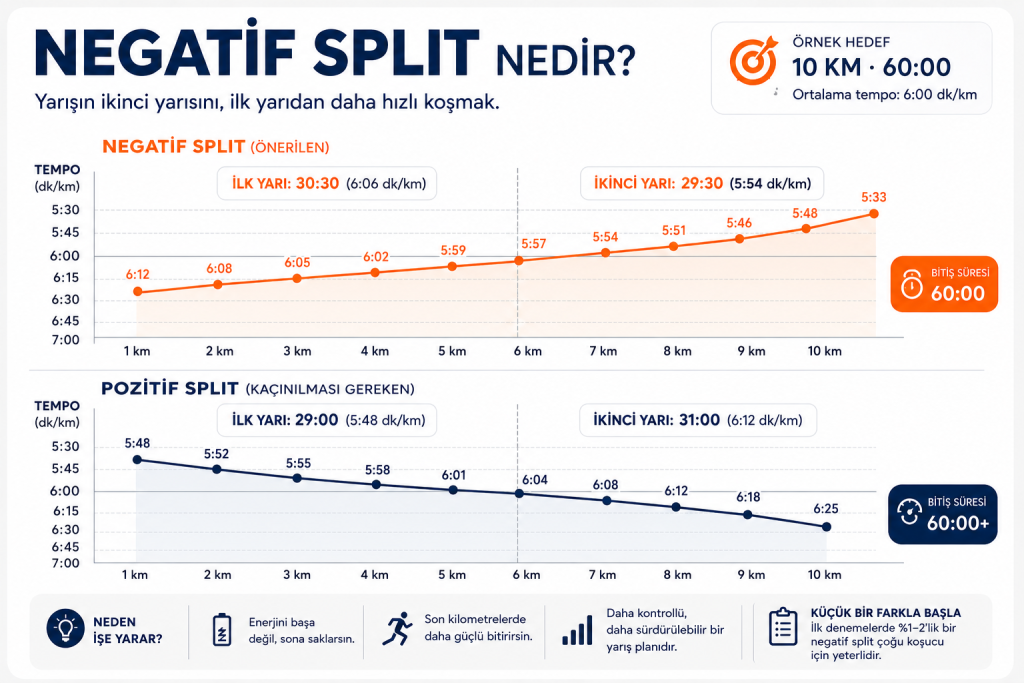
Enter your target finish time and race distance in the negative split plan section of the calculator above to build your kilometre splits.
If you’re trying a negative split for the first time, don’t make the gap between the two halves too big. Starting with a small difference makes the plan easier to stick to and helps you stay in control throughout the race.
A negative split isn’t a must for every race. Depending on things like the course profile, the weather and your race experience, an even pace or an effort-based plan may suit you better.
↑ Back to the top of this sectionWhy should your training pace be slower than your race pace?
Running every run as fast as you can doesn’t mean you’ll improve faster.
One of the most common mistakes new runners make is running their easy runs too fast. That can make recovery harder and leave your whole training week feeling constantly tiring.
Easy runs aren’t there to test your top speed. They’re there to build aerobic endurance, increase your running volume and get your body ready for the next session.
You can use the talk test to find your easy pace. If you can comfortably put short sentences together and keep your breathing under control while you run, you’re most likely at the right effort level.
If your breathing keeps cutting into your sentences and you’re struggling from the start of the run, you’re probably going too fast for an easy run. The basics of breathing while you run can come in handy here.
Your easy pace can vary with your fitness level, your target distance, the temperature, how hilly the course is and how tired you are that day. That’s why there’s no fixed range in seconds that works for everyone.
So don’t just watch the pace on your watch; pay attention to your breathing and your overall sense of effort too.
↑ Back to the top of this sectionPredicting your half marathon and marathon from your 10K time
Once you’ve worked out your pace, the question most runners ask next is: in this shape, how long would a longer distance take me? There’s a widely used method for that — the Riegel formula. It goes back to Pete Riegel and is used in many calculators to estimate race times.
The idea is simple: as the distance goes up, your speed drops, and the formula models that relationship approximately. The formula is T₂ = T₁ × (D₂/D₁)^1.06; when you double the distance, your time goes up not two times but roughly 2.08 times. It’s an estimate, not a guarantee of how you’ll actually perform.
| Your 10K time | Half marathon prediction | Marathon prediction |
|---|---|---|
| 40:00 | 1:28 | 3:04 |
| 45:00 | 1:39 | 3:27 |
| 50:00 | 1:50 | 3:50 |
| 55:00 | 2:01 | 4:13 |
| 60:00 | 2:12 | 4:36 |
| 65:00 | 2:23 | 4:59 |
| 70:00 | 2:34 | 5:22 |
Up to the half marathon the formula is a useful guide; for the marathon you need more caution. The formula was derived from race data. In a study of 2,303 recreational runners (Vickers and Vertosick, 2016), the estimates held up well on average up to the half marathon, but the Riegel calculation they examined was at least 10 minutes too optimistic for half of the participants in the marathon. The study used an exponent of 1.07 in its main comparison; the table here uses 1.06. For individual runners, half marathon estimates are uncertain too. In the marathon, factors such as your energy reserves and your long-run preparation also play a part, and this simple formula doesn’t capture them.
How to read it in practice: treat the marathon column as an optimistic guide; a realistic target doesn’t automatically follow from it. If you haven’t done marathon-specific endurance training, your real time may be noticeably longer.
Picked your target distance? Next up is the race: the Race Calendar lists running races in Turkey by date and city. If you’re curious about the energy side of your training, the running calorie calculator gives you what you burn based on your distance and pace.
↑ Back to the top of this sectionWhat affects your pace
The same runner can’t run the same distance at the same pace every day. Your pace isn’t set by your fitness level alone.
These are the main things that can affect your running pace:
- Whether the course is hilly or flat
- The surface underfoot
- Temperature
- Humidity
- Wind
- How well you’ve slept
- Fatigue left over from earlier sessions
- What you’ve eaten and how well hydrated you are
- Stops you take during the run
- GPS measurement errors
That’s why comparing two different runs on average pace alone won’t always give you the right answer.
A controlled run at 6:10 min/km on a hot, humid day can take more effort than a run at 5:50 min/km on a cool day.
Pace is an important number, but on its own it doesn’t show the whole picture of your performance.
↑ Back to the top of this sectionFrequently asked questions about calculating pace
01Is running 10 km in an hour a good time?
Running 10 kilometres in 1 hour works out at an average pace of 6:00 minutes per kilometre.
Whether that’s a good time depends on your running background. For someone new to running it can be a big goal, while for someone who’s been running regularly for a long time it can be a comfortable training pace.
The most meaningful comparison is with your own previous results and how your training is progressing.
02Can you work out your pace without a watch or phone?
Yes. All you need is to time your run on a course of known distance.
Run 10 laps of a 400-metre athletics track, for example, and you’ve covered 4 kilometres in total. Enter your time and distance into the calculator above to get your average pace and speed.
03Why is a half marathon 21.0975 kilometres?
The official marathon distance is 42.195 kilometres; this length is set by World Athletics, the international governing body for athletics. The half marathon is exactly half that distance: 21.0975 kilometres. You can see the other race lengths, from 5K to ultramarathon, in a single table in our Running Distances article.
Rounding the distance to 21 kilometres might look like a small thing, but it can make a difference when you’re working out target pace and finish time. The calculator uses the official lengths for the half marathon and marathon.
04Does pace work on hilly courses?
You can still work out the average pace of the run. But don’t expect your kilometre splits to be even.
Your pace can slow on the climbs and pick up on the descents. On courses like these, keeping an eye on your overall effort level and total time is more useful than trying to hold the same pace every kilometre.
On technical, steep ground like trail running, pace is affected more by the surface, the elevation gain and the weather. So don’t compare it directly with your pace on the road.
05How do you convert treadmill speed to pace?
The speed on a treadmill is shown in km/h. To turn it into pace, divide 60 by the speed.
If you’ve set the treadmill to 10 km/h, for example:
60 ÷ 10 = 6
That works out at a pace of 6:00 min/km. A speed of 12 km/h means a pace of 5:00 min/km.
06Why does the pace on my GPS watch keep changing?
The current pace on a running watch can be thrown by small changes in the GPS signal. Sharp turns, tree cover, tall buildings and tunnels can all cause short-lived errors.
That’s why tracking your lap average, your pace per kilometre or your total split time, rather than just your current pace, usually gives you a steadier picture.
07Why does my watch measure more than the official race distance?
Race courses are measured along the shortest possible running line. During a race, though, running wide on corners, steering round crowds or heading over to water stations can add to the distance you actually run.
Small GPS measurement errors can add to that too. So at the end of an official 10 km race, your watch may well show 10.10 or 10.20 kilometres.
Build your target pace plan around the official race distance, and keep an eye on the kilometre markers during the race as well.
08Does the calculator store my personal data?
No. All the calculations happen inside your browser; the distance, time and pace you enter aren’t sent to a server or saved. You don’t need to sign up or log in to use the calculator.
Only your choice of unit (kilometres or miles) and calculation mode is kept in your device’s own storage, so it’s ready for you next time. That preference never leaves your device either, and it’s deleted when you clear your browser data.
The bottom line
Working out your pace isn’t just about finding out how many minutes it takes you to run a kilometre. It also helps you set realistic race goals, plan your kilometre splits and manage your training in a more controlled way.
But don’t treat pace on its own as a definitive measure of performance. The course, the weather, fatigue and the purpose of the session can all make the same pace feel like a different effort on different days.
Use the calculator above to work out your pace, speed, target finish time and kilometre splits, then weigh the results against your own fitness level and race conditions.
Once you’ve found your pace, if you’re curious how many calories you burn at it, head over to the running calorie calculator; both work with the same figures.