
HYROX Rowing: Technique, Pacing and Race Rules for the 1,000 m Row
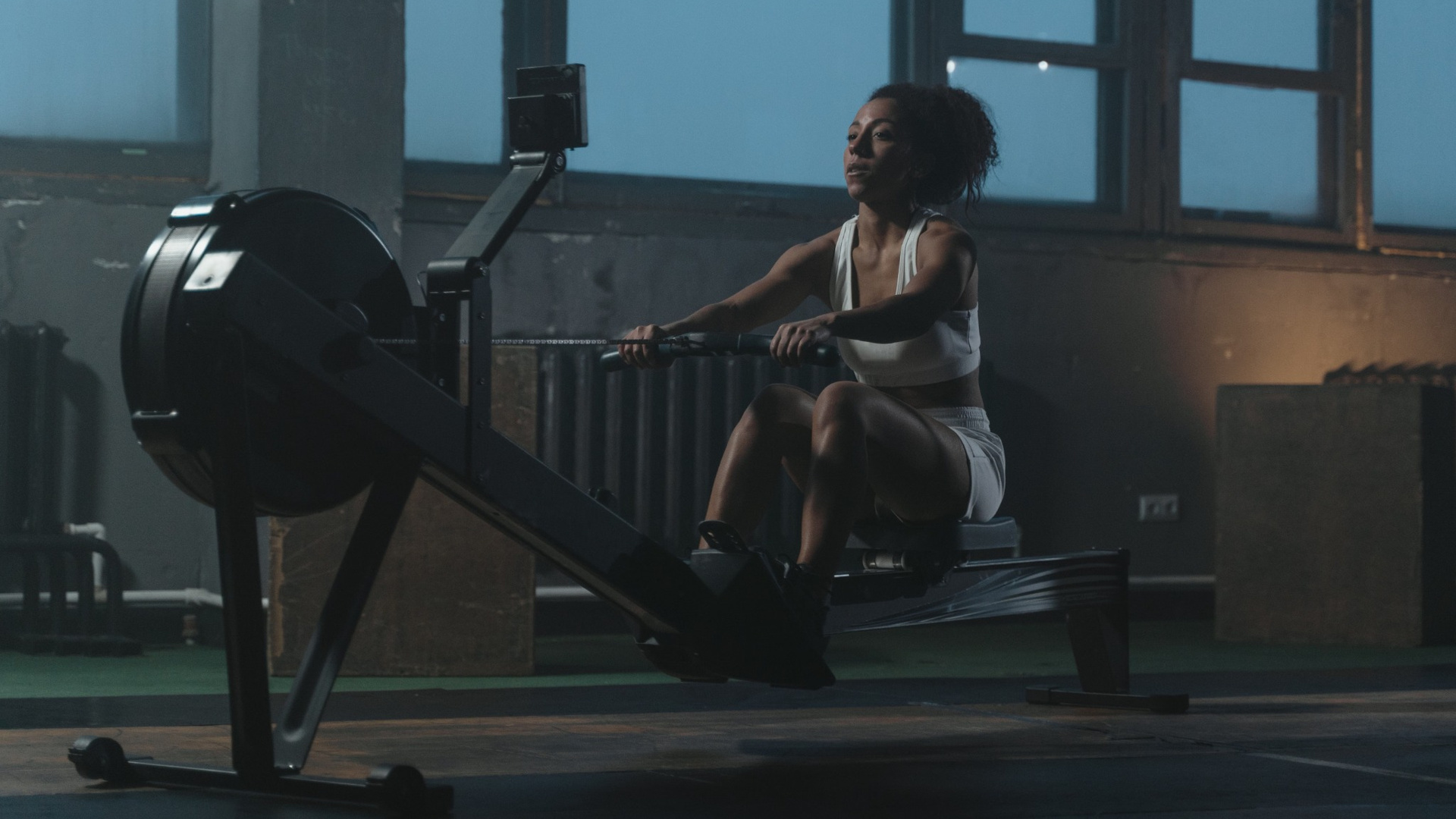
The burpee broad jumps are done. You’ve run another kilometre, and finally there’s a station you can do sitting down. At that point, the rowing machine’s seat can look pretty inviting. A few strokes later, though, it becomes clear: HYROX hasn’t put a rest stop here.
Rowing is the fifth station of the race. Your job involves more than pulling the handle until the distance is done. You need to bring your legs, body and arms together in one movement while saving some energy for the rest of the course. A good row also accounts for how well you can run when you get off the machine.
How does the HYROX rowing station work?
In a standard HYROX race, you complete a 1,000 m row after your fifth 1 km run. Burpee broad jumps come before it; another kilometre of running and the farmers carry follow. So, although a substantial part of the race is behind you, there’s still plenty left to do.
The rowing distance is the same for women and men in Singles, at both Open and Pro levels. Unlike some other stations, there’s no weight to select based on your division. The total station distance is also 1,000 m in Doubles and Relay. Adaptive divisions have their own distances and rules.[1][2][3]
The Concept2 RowErg used in HYROX is an air-resistance rowing ergometer. Don’t confuse it with the seated row weight machine at the gym: here, the seat slides along a rail, and the leg drive is an important part of the movement.[4]
Which muscles does rowing work?
With the handle in your hands, rowing can look like an arm and back exercise. But a strong stroke starts with your legs. Your quads work as you straighten your knees, while your glutes and hamstrings help extend your hips. Your core supports your posture, and your back and arms contribute as the stroke continues.[5]
That’s why “My legs did the running; I’ll let my arms take over now” doesn’t really work on the rower. Without the leg drive, you’re leaving much of the job to smaller muscle groups. A handle that feels heavier doesn’t necessarily mean you’re rowing better.
What should you adjust when you sit down?
With race-day excitement taking over, it’s easy to sit down and start pulling straight away. But discovering that your feet aren’t properly positioned a hundred metres in can be more trouble than making a quick adjustment at the start.
Footplates and straps
Adjust the footplates so the straps sit across the widest part of your feet. You want your shoes held securely, without being squeezed unnecessarily. Your foot position should also let your knees and hands move without getting in each other’s way.[6]
Try this setup in training with the shoes you plan to race in. Different sole thicknesses can make the same footplate position feel different. Knowing which footplate number suits you sounds like a small detail, but it’s one less adjustment to think about during the race.
Damper setting
The lever numbered 1–10 beside the fan controls the damper setting. It changes how much air enters the fan housing and affects how each stroke feels. Thinking of it like adding plates to a weight machine is misleading: the force you apply and the speed of your movement also determine how hard you work on the rower.[7]
Under the 2026/27 Singles rulebook, the damper is initially set to 6 and the footplates to position 4. You can change the damper during the race and adjust the footplates to suit you before starting. Finding the machine set to 6 doesn’t mean you have to row at that setting.[1]
Concept2 generally recommends starting in the 3–5 range. That doesn’t mean everyone should use the same setting. Experiment in training to find an option that lets you maintain your technique. Turning the damper up to 10 won’t impress the monitor.[7]
There’s also drag factor: a measure of how much the fan slows between strokes. The same damper number can feel different on different machines. Rather than relying entirely on the number beside the lever, it helps to recognise the feel of the stroke you’re used to.[7]
Rowing technique: Legs, body, arms
When learning the movement, this sequence can help: legs–body–arms on the drive, then arms–body–legs on the recovery. These are connected parts of one movement, rather than separate exercises with pauses between them.[4]
1. The starting position
Keep your arms long and your shoulders relaxed. Lean slightly forward from your hips. Bring your shins as close to vertical as you comfortably can, without rounding your lower back to reach further. Your heels may lift a little, depending on your range of motion.[4]
2. The drive and pull
Start by pushing against the footplates with your legs. Keep your arms long initially, rather than bending them straight away. As the leg drive continues, your torso opens up; then your elbows bend and the handle comes towards your lower ribs. A slight backward lean at the finish is enough. There’s no need to recline on the seat.[4]
3. A controlled recovery
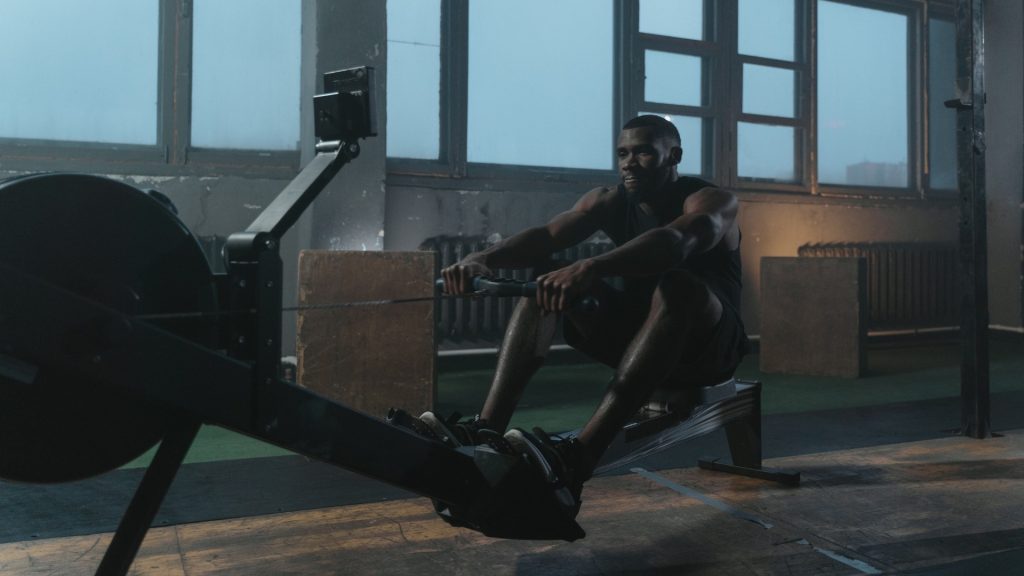
Extend your arms first, then hinge forward from your hips. Once your hands have passed your knees, bend your knees and slide the seat forward. If your knees come up too early, you’ll have to move the handle around them. Keep the chain’s path as straight as possible.[4]
In training, try allowing a little more time for the return after each drive. The approximate 1:2 drive-to-recovery ratio in Concept2’s HYROX advice can help you learn that rhythm. You don’t need to count seconds on every stroke; the aim is to avoid rushing the seat forward without control.[8]
What do pace and stroke rate on the monitor mean?
The most useful numbers on the rowing monitor are distance, 500 m pace and strokes per minute. The last of these may appear as s/m or spm.
Your 500 m pace shows how long it would take you to cover 500 metres at your current speed. For example, an average pace of 2:30/500 m works out to a 5-minute row over 1,000 m. That calculation doesn’t include time spent getting onto or off the machine.
| Average rowing pace | Time for 1,000 m |
|---|---|
| 2:00 / 500 m | 4:00 |
| 2:15 / 500 m | 4:30 |
| 2:30 / 500 m | 5:00 |
| 2:45 / 500 m | 5:30 |
| 3:00 / 500 m | 6:00 |
This table isn’t a performance ranking. It’s simply a way to translate the number on the monitor into a finish time.
Stroke rate tells you how frequently you’re moving. A higher number doesn’t automatically mean more speed. Short, rushed strokes can have you doing plenty of moving without covering as much distance as you expect. When you transfer your leg drive effectively to the handle, you can produce a strong pace at a lower stroke rate too.[9]
To find your rhythm, try holding the same comfortable pace at different stroke rates. Notice where your movement stays most consistent, how you’re breathing and how hard the effort feels. You don’t have to choose the rhythm that looks busiest.
How should you pace the 1,000 m during the race?
Taking your fastest fresh 1,000 m time and using it directly as your HYROX target can be misleading. During the race, you arrive at the machine already tired—and you’ll be running again when you leave it.
As a starting point, try this approach in training:
- First 100–150 m: Bring the machine up to speed smoothly, then settle into your planned pace. Avoid sprinting just to see an impressive number flash up on the monitor.
- Middle section: Keep your rhythm with strokes of similar power. If your pace is fluctuating, check your movement first rather than immediately trying to row more frequently.
- Final 200 m: If your breathing and technique are under control, try gradually increasing your speed. Include the start of the next run in that decision.
This is a practical approach to test while finding your own pace, rather than a race rule or a universal time prescription.
For example, rowing at an average of 2:15 instead of 2:20/500 m saves 10 seconds over 1,000 m. If that faster row costs you 20 seconds on the next run, you’ve lost time overall. That’s a good reason to consider more than your finish time on the machine when choosing a rowing target.
Common technique mistakes
Bending your arms too early
Trying to pull with your arms from the very start makes it harder to use your leg drive. Focus on pushing against the footplates first, and let the arm pull come at the right point in the sequence.[10]
Sending the seat back without bringing your body with it
If your hips slide backwards but the handle barely moves, your leg movement may not be connecting effectively to the stroke. A short training video filmed from the side can make this easier to spot.[10]
Gripping the handle too tightly
Keep your wrists flat and hold the handle securely but comfortably with your fingers. If your forearms are tiring early, take a look at your grip. There’s plenty of room between letting the handle slip and hanging onto it for dear life.[10]
Overreaching to make the stroke longer
Rounding your lower back at the front or leaning too far back at the finish can add length while taking you out of a strong position. Find a comfortable, controlled range of motion first, rather than trying to extend the stroke by throwing your torso around.[10]
Race rules to keep in mind
The following summarises the 2026/27 Singles rowing rules:
- The judging team resets the monitor before you start.
- You must remain seated until the distance is complete. You may rest, place the handle in its holder and take your feet off the footplates.
- You must not stand up or get off the machine until you have completed 1,000 m and a judge has confirmed completion.
- For rowing infringements, the first infringement brings a warning and the second a 15-second penalty. Each subsequent infringement adds another 15 seconds.[1]
Avoid rushing those final metres. Instead of taking your last stroke and standing up immediately, wait for the distance on the monitor and the judge’s confirmation. Practise getting off the machine in training too. Undoing the straps shouldn’t be something you figure out for the first time on race day.
How can you include rowing in your HYROX training?
Every rowing session doesn’t need to be a time trial. Learning technique, getting familiar with your pace and practising the transition to running are different tasks. You can use the examples below on separate days, depending on the load of your existing programme.
Getting comfortable with technique: 4 × 3 minutes
After a short warm-up, row for 3 minutes at an easy effort, with around 1 minute of rest between intervals. Focus on one detail in each of the four intervals: movement sequence, a straight handle path, a controlled recovery or a relaxed grip. Aim to repeat the movement consistently rather than increase your speed.
Getting familiar with your pace: 3 × 500 m
Choose a pace at which you can maintain your technique. Rest for 90–120 seconds between repetitions. If you row the first 500 m very fast and slow down considerably on the others, ease back on your initial target. The aim is to complete all three repetitions with similar quality.
Practising the transition to running: Run–row–run
Complete a controlled 500 m run, a 500 m row and another 500 m run. One round may be enough for your first attempt. Pay particular attention to how the second run starts: can you find your rhythm after the row, or do you need to walk to recover?
These examples aren’t a complete training programme. If you’re new to rowing, you can reduce the distances and number of repetitions. Don’t continue through sharp or increasing pain. If you’re struggling with technique, ask a coach to watch you from the side.
At your next rowing session, record more than your finish time. Note your average pace, the setting you used and how you felt running afterwards. Seeing those three things together will give you a clearer idea of a pace you can use on race day.
Sources
The rules have been summarised from the 2026/27 season rulebooks accessed on 24 October 2026. Technique and training suggestions should be considered separately from official race rules.
- HYROX Singles Rulebook 2026/27 — Rowing, section 8.5
- HYROX Doubles Rulebook 2026/27
- HYROX Relay Rulebook 2026/27
- Concept2 — Indoor Rowing Technique
- Concept2 — Muscles Used While Rowing
- Concept2 — Find Your Optimal Foot Position on the RowErg
- Concept2 — All About Damper Setting and Drag Factor
- Concept2 — Erg HYROX Tips and Tricks
- Concept2 — Low Stroke Rates: Rowing Faster by Going Slower
- Concept2 — Improve Your Rowing Technique