
What is a farmer’s carry? Proper technique, muscles worked and its role in HYROX
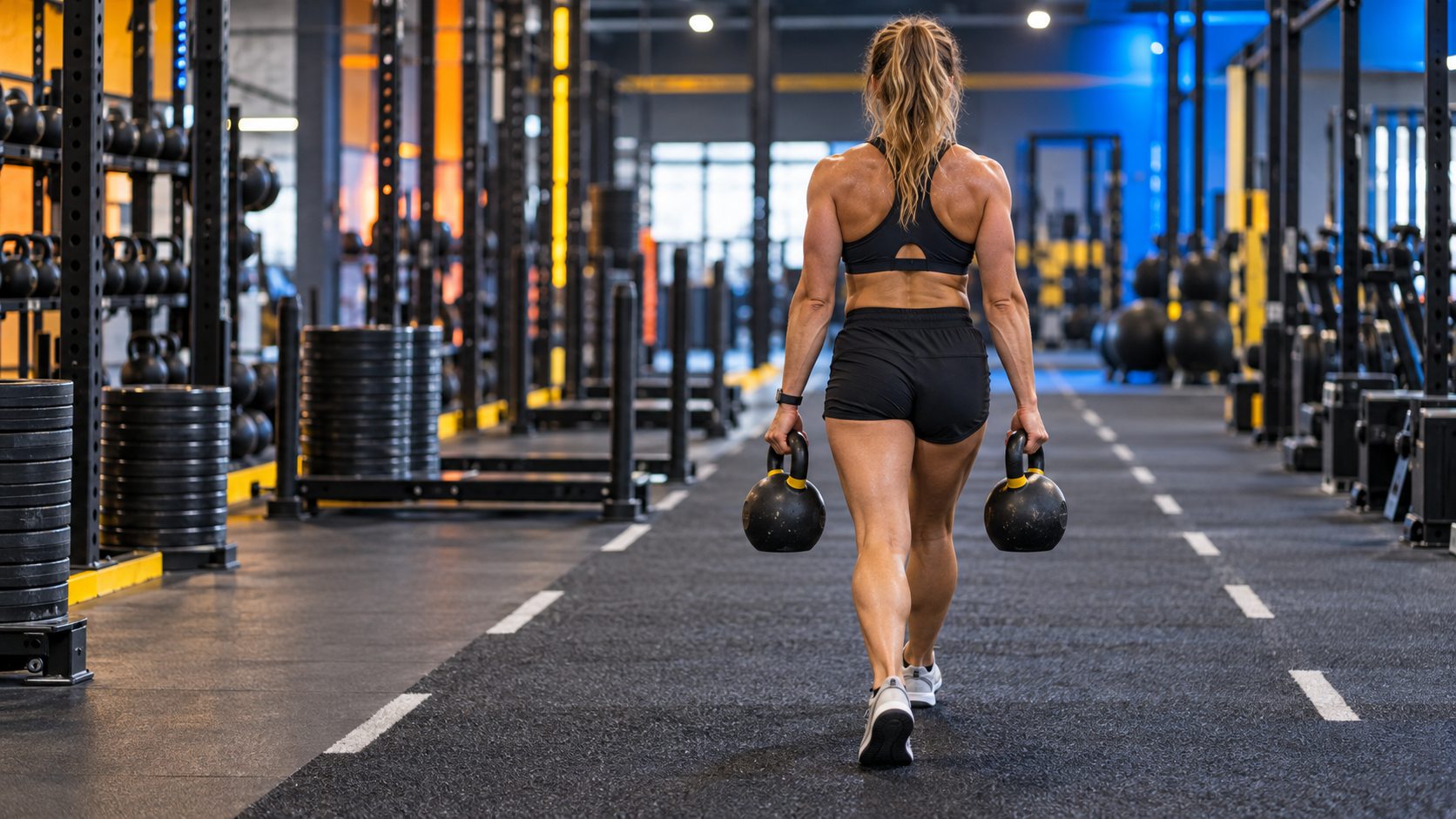
Pick up a weight in each hand and walk. Sounds like child’s play, right? You might have watched it in HYROX and thought, “I could do that.” After all, didn’t we all help carry the shopping home with a bag in each hand as kids? Jokes aside, a few steps into a farmer’s carry, you may discover that your grip, shoulders and torso have other ideas. The challenge is keeping everything under control while you walk, as well as getting the weights off the floor. So what is a farmer’s carry, which muscles does it work, and why does it have its own station in HYROX? Let’s look at the technique and a simple plan you can use to get started.
What is a farmer’s carry?
A farmer’s carry is an exercise where you walk for a set distance or time while holding a weight in each hand. In the gym, it’s most often done with kettlebells or dumbbells. You grip the weights, keep your torso stable and move forwards without letting your steps fall apart.
Because several muscle groups work at once, the farmer’s carry is often described as a full-body exercise. That doesn’t mean it trains every individual muscle, though. Your hands and forearms hold the weights, while your upper back and the muscles around your shoulders help support the load. Your core controls leaning forwards or sideways, and your glutes and legs keep you walking. This simple-looking movement puts several parts of your body to work together.
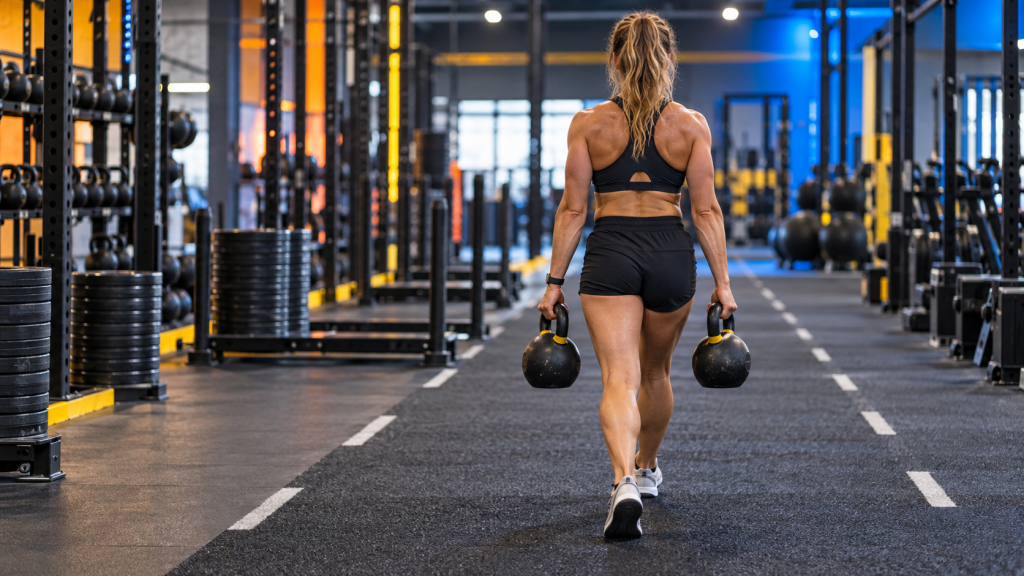
Which muscles does a farmer’s carry work?
Most people first notice fatigue in their hands and forearms. As you keep holding the weights, the muscles responsible for your grip stay active. Your traps and upper back also help maintain the position of your arms as they carry the weights at your sides.
Your core works to stop you swaying from side to side or folding forwards as you walk. Your glutes and legs help you take each step and maintain your balance. So a farmer’s carry is more than a forearm exercise: your grip, upper back, core, glutes and legs all contribute.
That combined effort can be useful for runners and other endurance athletes, too. The exercise can form part of strength training aimed at maintaining posture and torso control under fatigue. We can’t say it will improve running performance on its own, and it doesn’t replace running training. But when it fits your programme, it’s a useful strength exercise.
How to do a farmer’s carry with proper technique
Start with a weight you can control. The aim is to maintain your posture and steps throughout the walk, rather than simply manage a few steps.
- Pick up the weights safely. Place the dumbbells or kettlebells on either side of your feet. Move your hips back and bend your knees to grip the handles. Don’t round your lower back to reach for the weights.
- Stand tall and prepare your core. Gently brace your abdomen as you stand up with the weights. Keep your rib cage over your pelvis and avoid excessively arching your lower back.
- Keep your shoulders in a natural position. Don’t shrug them towards your ears or pin your arms behind you. Keep your shoulder blades controlled and stay upright without forcing your chest forwards.
- Take short, steady steps. Steps slightly shorter than your usual walking stride can reduce swinging. Place your feet with control, and don’t rush or try to run.
- Put the weights down with control. Don’t throw them onto the floor at the end of the set. Stop, establish a stable footing, then move your hips back and bend your knees to lower the kettlebells or dumbbells.
Look a few metres ahead without letting your head drop forwards. If the weights hit your legs, your body leans to one side or your steps become uneven, reduce the load or shorten the distance.
The farmer’s carry in HYROX: station 6 and 200 metres
In a HYROX race, the farmer’s carry is the sixth workout station in the sequence of runs and exercises. Participants carry a kettlebell in each hand for 200 metres. The official HYROX race description also identifies the upper back, core and grip strength as areas involved at this station.
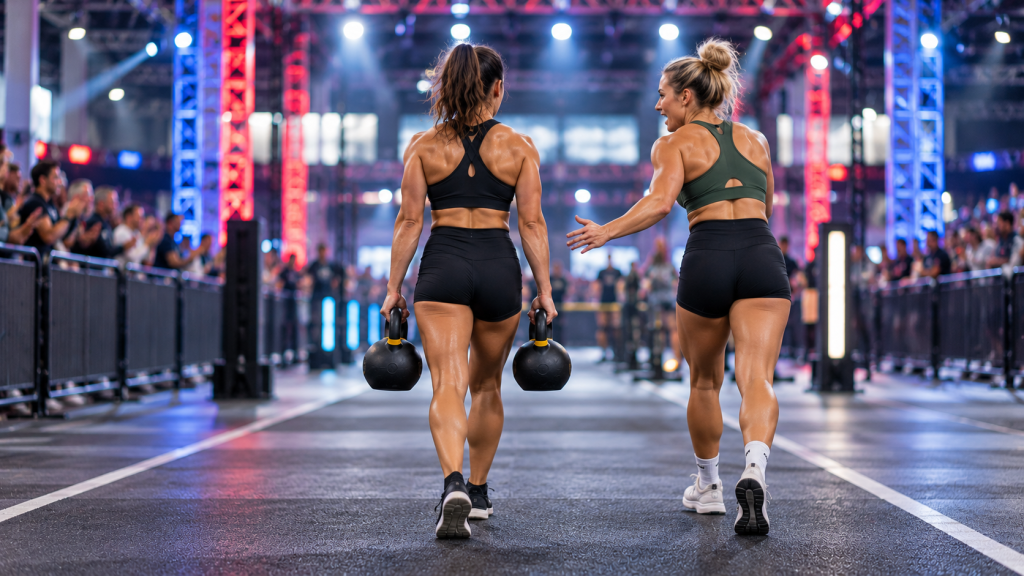
This section is about more than how much weight you can carry. By the time you reach it, you’ve already been running and completed other stations. A weight that feels manageable when you’re fresh at the gym may feel surprisingly heavy at this point in the race. If you’re preparing for HYROX, occasionally practise farmer’s carries after a run or another station. That way, you work on keeping the movement controlled when you’re tired, too.
The weights used vary by HYROX division, and the rulebook may be updated. To check the current loads for the division you’ll be racing in, see our guide to HYROX divisions and weights.
What should you do when your grip starts to go?
If your fingers start opening, your wrists bend or the kettlebells swing uncontrollably during training, don’t force yourself to keep the set going. Put the weights down safely, relax your hands briefly and get your breathing back under control. When you’re ready, grip the handles again and continue walking.
These short breaks can help you finish the total distance without losing your form. Over time, you may be able to walk farther with the same weight, or split the total distance into several sections. If you need to put the weights down during a race, follow the current rules for your division and the judge’s instructions.
Common mistakes
- Starting too heavy: Your grip tires quickly, and your shoulder and torso position deteriorates.
- Shrugging your shoulders towards your ears: This creates unnecessary tension in your neck and shoulders.
- Swinging the weights: This makes them harder to control and disrupts your walking rhythm.
- Taking overly long strides: This can make your torso sway and cause the weights to hit your legs.
- Rounding your lower back: When picking up or putting down the weights, move your hips back and bend your knees instead.
- Continuing after your form breaks down: Put the weights down, rest or reduce the load if your technique falls apart.
A weekly farmer’s carry plan for beginners
You can start by adding the exercise to the end of your general strength session once a week. In the first week, use light dumbbells or kettlebells for three sets of 20–30 metres. Rest for around 60–90 seconds between sets. The weight should be light enough that you’re still upright and walking with control on the final step.
In the example below, you gradually increase the distance and try the suitcase carry in the final week. Increase only one thing each week: distance, number of sets or weight. Don’t raise all three at once.
| Week | Exercise | How to do it |
|---|---|---|
| 1 | Dumbbell farmer’s carry | 3 × 20–30 m at an easy, controlled pace |
| 2 | Kettlebell farmer’s carry | 3 × 25–35 m, using the same light load if you can maintain your form |
| 3 | Dumbbell or kettlebell farmer’s carry | 4 × 25–35 m, with 60–90 seconds of rest between sets |
| 4 | Suitcase carry | Hold a weight in one hand for 3 × 15–20 m per side; keep your torso upright |
This example isn’t a fixed prescription for everyone. If you have a condition affecting your lower back, shoulders, wrists or grip, speak to a healthcare professional or qualified trainer before trying the exercise. Stop the set if you feel pain.
What is a suitcase carry?
A suitcase carry is the one-handed version of a farmer’s carry. You walk while holding a kettlebell or dumbbell in one hand, trying not to lean towards the weighted side. Your core muscles resist that sideways pull.
To begin with, work both sides for the same distance and time. If your shoulder drops or your steps become uneven as you walk, reduce the weight or shorten the distance.
Who is the farmer’s carry suitable for?
Many people who can walk and grip weights safely can add farmer’s carries to their strength training. But an exercise looking easy isn’t a reason to start heavy. First, establish your posture and walking technique with a light weight. Then gradually increase the distance or load.
If you’re preparing for HYROX, you can occasionally practise in a sequence that resembles race conditions. For general strength training, there’s no need to turn every set into a race simulation. Start with controlled walking and sound technique. You should be in charge of the weights, rather than the other way around.
Sources
- HYROX — The Fitness Race — Race format and description of the 200 m farmer’s carry.
- HYROX — Official Rulebook — Details of the sixth station, distance and weights.
- The Quantification of Muscle Activation During the Loaded Carry Movement Pattern — Study of muscle activation during loaded carry exercises.
Frequently asked questions
Which muscles does a farmer’s carry work?
Primarily the hands and forearms, traps and upper back, core, glutes and legs. Which area tires first can vary with the weight and the length of time you’re walking.
How much weight should I start with?
There’s no single weight that suits everyone. Start light. If you can’t maintain an upright posture, a natural stride and a controlled grip throughout the set, reduce the load.
Are a farmer’s carry and a farmer’s walk the same thing?
Yes. Both terms refer to walking while carrying a weight in each hand.