
HYROX divisions and weights: Open, Pro or Doubles?
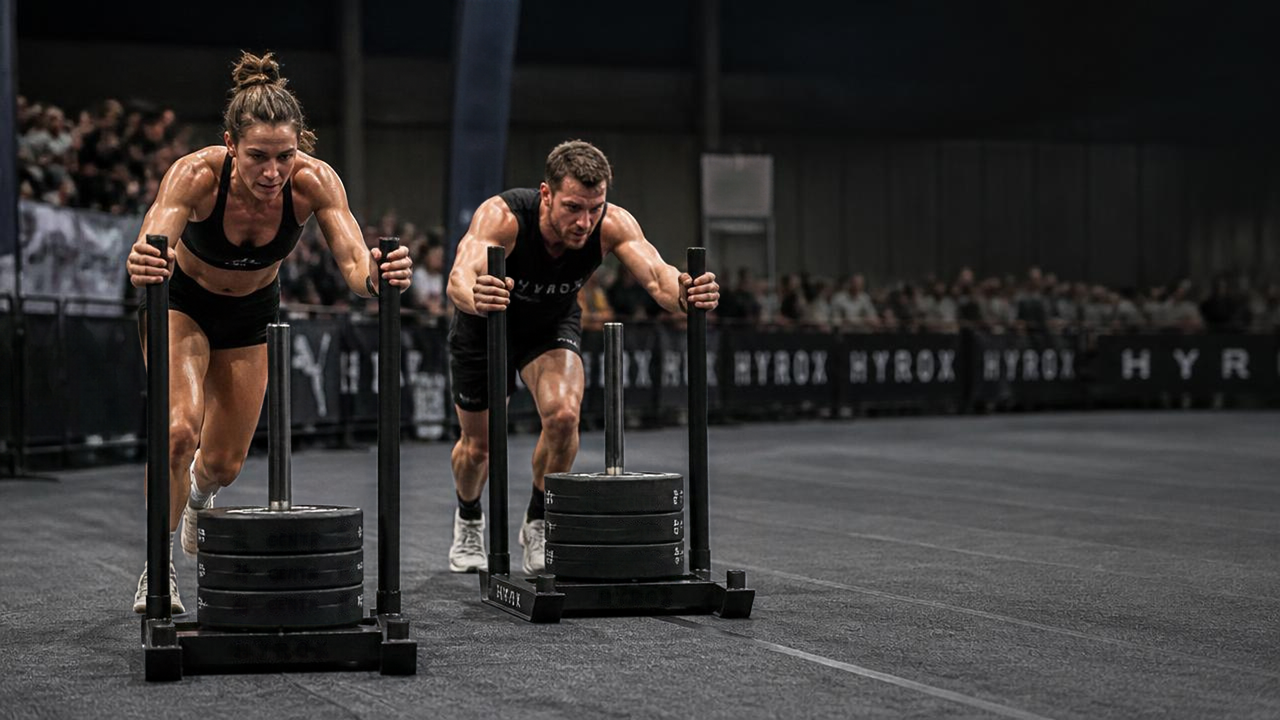
If you’re thinking about signing up for your first HYROX, the race format is fairly easy to get your head around. Even if you can’t remember the exercise names or the order of the stations, the idea is simple: run 1 kilometre, complete a workout station, then run another kilometre. By the finish, you’ll have completed eight runs and eight stations. The confusion usually starts on the next screen, when you have to choose a HYROX division. Open or Pro? Singles or Doubles? And what changes if you pick Relay?
Your division determines more than which results list your name appears on. It also affects the weights you’ll face at the stations. The word “Pro” can be a little misleading, too: you don’t have to be a professional athlete to enter. But don’t take that to mean it’s an easy option. The loads increase considerably, and the athletes around you tend to be pretty strong.
Let’s look at where the differences begin, using the official HYROX rules for the 26/27 season. I won’t go through the basic format, the order of the eight stations or how the race unfolds again here. For that, head to our What Is HYROX and How Does It Work? guide. This article is all about choosing your division and knowing what weights to expect.
HYROX divisions: Singles, Doubles, Relay and Adaptive
Racing on your own isn’t the only way to take part in HYROX. There are four main formats to choose from:
- Singles: You complete the entire race on your own. Open and Pro options are available.
- Doubles: You race as a team of two. You can share the work at the stations, but you do the runs together.
- Team Relay: You race in a team of four. The eight runs and eight stations are divided between the four athletes.
- Adaptive: A separate race division adapted for specific physical disabilities or impairments.
For Singles, the official 26/27 divisions are Women, Women Pro, Men and Men Pro. Moving up a division doesn’t change the running distance: everyone still runs a total of 8 km. The difference comes at the weighted stations. So thinking of Open and Pro as “the easy race” and “the hard race” doesn’t quite capture it. A better question is: do you want to complete the same race format with heavier loads?
Open vs Pro: what actually changes?
Open and Pro have the same running distance and the same number of rounds. The differences show up when you reach the stations. These distances stay the same in both divisions:
- SkiErg: 1,000 metres.
- Rowing: 1,000 metres.
- Burpee Broad Jumps: 80 metres.
- Farmers Carry: 200 metres.
- Sandbag Lunges: 100 metres.

The bigger differences involve the sleds, kettlebells, sandbags and wall balls. In the men’s divisions, for example, the Sled Push goes from 152 kg in Open to 202 kg in Pro. For the Farmers Carry, you carry 2 × 32 kg instead of 2 × 24 kg. The Sandbag Lunges go from 20 kg to 30 kg, and the Wall Balls use a 9 kg ball rather than a 6 kg one.
So moving to Pro doesn’t add any running distance, but it does add a lot more strength work on top of those runs. There’s a good chance you’ll feel that difference most in the second half of the race.
HYROX Open and Pro weights: 26/27 season
Here are the weights listed in the official Singles Rulebook for the 26/27 season:
| Station | Women Open | Men Open | Women Pro | Men Pro |
|---|---|---|---|---|
| SkiErg | 1,000 m | 1,000 m | 1,000 m | 1,000 m |
| Sled Push | 102 kg | 152 kg | 152 kg | 202 kg |
| Sled Pull | 78 kg | 103 kg | 103 kg | 153 kg |
| Burpee Broad Jumps | 80 m | 80 m | 80 m | 80 m |
| Rowing | 1,000 m | 1,000 m | 1,000 m | 1,000 m |
| Farmers Carry | 2 × 16 kg | 2 × 24 kg | 2 × 24 kg | 2 × 32 kg |
| Sandbag Lunges | 10 kg | 20 kg | 20 kg | 30 kg |
| Wall Balls | 4 kg | 6 kg | 6 kg | 9 kg |
The sled weights in the table are total weights, including the sled itself. You’ll also notice something interesting: Men Open and Women Pro use the same weights. That’s why it helps to look at both the division and the men’s or women’s category, rather than simply assuming that Open means light and Pro means heavy.
What do white, grey and black mean?
Some HYROX equipment is colour coded, so you don’t have to keep doing weight calculations on the race floor. For Farmers Carry, Sandbag Lunges and Wall Balls, the colours correspond to these weights:
| Colour | Farmers Carry | Sandbag Lunges | Wall Ball |
|---|---|---|---|
| White | 2 × 16 kg | 10 kg | 4 kg |
| Grey | 2 × 24 kg | 20 kg | 6 kg |
| Black | 2 × 32 kg | 30 kg | 9 kg |
The official rules make it clear that choosing the correct weight is the athlete’s responsibility. Learn which weights your division uses before race day. Realising halfway through a station that you picked up the wrong equipment is fairly high on the list of things you don’t want to happen.
The Wall Ball detail that often causes confusion
If you only look at the ball’s weight, the Wall Ball setup can seem a bit confusing. Men Open and Women Pro both use the grey 6 kg ball, but they don’t use the same target height. Under the 26/27 rules, the target is 2.70 metres for Women and Women Pro, and 3.00 metres for Men and Men Pro. A Women Pro athlete throws a 6 kg ball to a 2.70-metre target, while a Men Open athlete throws the same weight to a 3.00-metre target. Your division determines the ball weight; the men’s or women’s category determines the target height.
Wall Balls being the final station might sound reassuring, but there’s one small catch: you still have 100 reps to do. A difference that looks like “just a ball that’s 2 kg heavier” feels rather less small once you’re working through all 100.
How does HYROX Doubles work?
Doubles is one of the most appealing options for a first HYROX. But there’s a common misunderstanding: “There are two of us, and we share the stations, so surely we share the running too?” Unfortunately, that’s not how it works. Both of you must complete all eight 1-kilometre runs. And running together really does mean together: you need to enter each station together and leave together once the work is done.
The benefit is that you can share the work at the stations. One person doesn’t have to do every Wall Ball rep, for example, and you can switch with your teammate at the other stations too. That changes the race strategy completely. If one of you is stronger at the heavy stations and the other handles high reps better, you don’t have to split everything 50–50. Dividing the work around your strengths can make much more sense.
For the 26/27 season, the Doubles divisions are Doubles Women, Doubles Women Pro, Doubles Men, Doubles Men Pro and Doubles Mixed. Both athletes still run a total of 8 km. That’s the idea behind Doubles: run together, share the station workload.
Team Relay works very differently
With a four-person Relay team, the race really is divided up. Each team member completes two 1-kilometre runs and two stations. There isn’t a fixed arrangement that says the first athlete must do the first two stations, either. Your team can decide who takes which run-and-station pairs.
Relay has Women, Men and Mixed divisions. A Mixed team consists of two women and two men. Relay weights don’t increase to Singles Pro level: women use the Women Open loads, and men use the Men Open loads. The Sled Push, for example, is 102 kg for women and 152 kg for men, while the Wall Ball weights are 4 kg and 6 kg respectively.
That makes Relay a different way into HYROX if you want to experience the atmosphere with friends but aren’t ready to take on all eight stations and 8 km of running on your own.
My first HYROX: which division should I enter?
There isn’t one right answer for everyone, but this table should make the choice a little easier:
| Your situation | A sensible starting point |
|---|---|
| It’s my first HYROX, and I want to race on my own | Singles Open |
| I’m a good runner, but I’m new to the strength stations | Singles Open |
| I have a strength training background, but no HYROX experience | Usually Singles Open |
| I handle the Open weights comfortably in training and regularly train with heavier loads | Pro could be worth considering |
| I want to race with a friend | Doubles |
| I want to share the station workload, but I can run 8 km | Doubles |
| There are four of us, and we’re trying HYROX for the first time | Relay |
| I’m mainly interested in experiencing the HYROX atmosphere | Doubles or Relay |
Especially for a first race, “I’m strong, so I’ll enter Pro” can be a bit of a rushed decision. Being able to lift a weight on its own is one thing. Handling it just as comfortably at a station squeezed between runs is another. Moving a 202 kg sled in the gym is great, but pushing it during a race, with your heart rate already up, is a different experience. When choosing a division, the strength you can sustain at race effort matters more than your maximum strength.
Choosing Open doesn’t mean choosing an easy race
The name Open can give the wrong impression. If you’re new to HYROX, it’s easy to picture it as the beginner or lighter version of the race. But the numbers tell a different story: you still have 8 kilometres of running and eight stations. There’s still a 152 kg Sled Push for men or a 102 kg Sled Push for women waiting for you. And the race still ends with 100 Wall Balls. Choosing Open means racing with the standard loads. Pro adds heavier station loads to that same race.
For a first HYROX, Open also gives you something useful: a real feel for race effort. You find out which stations fall apart after the runs, where you started too fast and which movement takes much longer than you expected. By your second race, you have an actual result to work with rather than a guess. That puts you in a much better position to decide whether to move up to Pro.
When does moving from Open to Pro make sense?
Before looking at your finish time, I’d ask this: are Pro weights already part of your training? If you’re trying a 202 kg sled for the first time two weeks before race day, you might be taking on an unnecessary challenge just to say you entered Pro. For median finish times by division, we’ve put together a separate guide: How Long Does HYROX Take, and What Is a Good Finish Time?
But if you regularly train with Pro sled weights, carrying 2 × 32 kg feels familiar, you can get back to running after 30 kg Sandbag Lunges, and you can manage high reps with a 9 kg wall ball, the picture changes. You also need to be able to do those things alongside running, rather than only when you’re fresh. In HYROX, what matters is whether you can still handle a weight after a run. When Pro weights stop being a special occasion in training and become part of your normal sessions, entering Pro starts to make much more sense.
Your shoe choice matters in every HYROX division
Whether you’re racing Open, Pro or Doubles, you’ll notice how well your shoes grip the floor once you reach the sled. A very soft shoe, or one with poor grip, might feel fast on the runs but offer less help at the stations. A few slips during the Sled Push or Sled Pull usually make that clear pretty quickly.
We’ve covered this in more detail in What Makes a Good HYROX Shoe? And if you’d rather look at race mistakes than equipment, take a look at our guide to 7 Common HYROX Mistakes.
Which HYROX division is right for you?
Entering Pro for your first HYROX doesn’t make you a more serious athlete, and choosing Open doesn’t make your race less of an achievement. What matters is which division gives you the best chance of putting together a good race. If you want to experience the whole format on your own, Singles Open is a sensible starting point for most people. If you can run 8 kilometres but want to share the station workload with a partner, Doubles offers a different race experience. And if you’re coming with a group of four and everyone wants to take on part of the race, that’s exactly what Relay is for.
Pro makes sense as a next step once those heavier weights already feel familiar in training. One last thing: when checking HYROX divisions and weights, avoid relying on old social media posts or tables put together years ago. Rules and standards can change between seasons. The figures in this article were checked against the official HYROX 26/27 rulebooks dated 24 June 2026.