
How to Do a Burpee: Beginner Tips, Common Mistakes and HYROX Technique
On your first burpee, you think, “What’s the big deal?” By the fifth, you’re talking a little less. By the tenth, you’re wondering why your coach put this exercise in the workout at all. That was pretty much my experience when I first tried it. Years later, I’m still not entirely sold on burpees. Of course, HYROX has become popular in the meantime, and burpees have found their way onto my own list of exercises to practice. You start standing, get down to the floor, get back up and, depending on the version, jump. A short sequence on paper. Do a few in a row, and it doesn’t feel quite so short. Today, we’ll answer questions like “How do you do a burpee?”, “Does every rep need a push-up?”, “Where should a beginner start?” and “Is a HYROX burpee broad jump the same as a regular gym burpee?” Let’s learn the movement first. Getting your heart rate up is the easy part. Staying in control is what matters. Let’s get started.
What is a burpee?
A burpee is a bodyweight exercise where you start standing, move down to the floor and get back up. Common versions include a plank, a push-up or a chest-to-floor movement, and a jump.
If you’re learning it for the first time, you’ll come across different versions. Don’t let that throw you. One workout might leave out the push-up, while another asks you to touch your chest to the floor. Beginners can also leave out the jump.
So if someone writes “10 burpees” in your program, first check which version they mean. A stepping burpee without a push-up doesn’t put the same demands on your body as a chest-to-floor burpee with a jump. We’ll start with a common version that includes a push-up and a vertical jump. Then we’ll look at easier options and how the movement changes for HYROX.
How to do a burpee: step-by-step technique
For your first attempt, find a surface that won’t slip and give yourself enough space to move comfortably. If you’re at the gym, stay out of the walkway. Let’s avoid coming face to face with someone just as you stand up. Some workouts use a time limit instead of a rep count. Leave that aside for now. We’re learning the movement, so there’s no need to squeeze as many burpees as possible into 30 seconds.
Start with a few minutes of easy movement. Warm up your wrists, shoulders and ankles, then try a few controlled squats and transitions into a plank.
1. Start standing and lower into a squat
Stand with your feet roughly hip-width apart. Bend your knees and move your hips back and down until you can place your hands on the floor. Set your hands about shoulder-width apart. Don’t force yourself into an awkward position to reach the ground; you don’t need to hit a particular squat depth here. If you can’t reach the floor comfortably, try the raised support we’ll cover shortly. Tipping forward as you put your hands down? Slow that transition down first.
2. Move your feet back into a plank
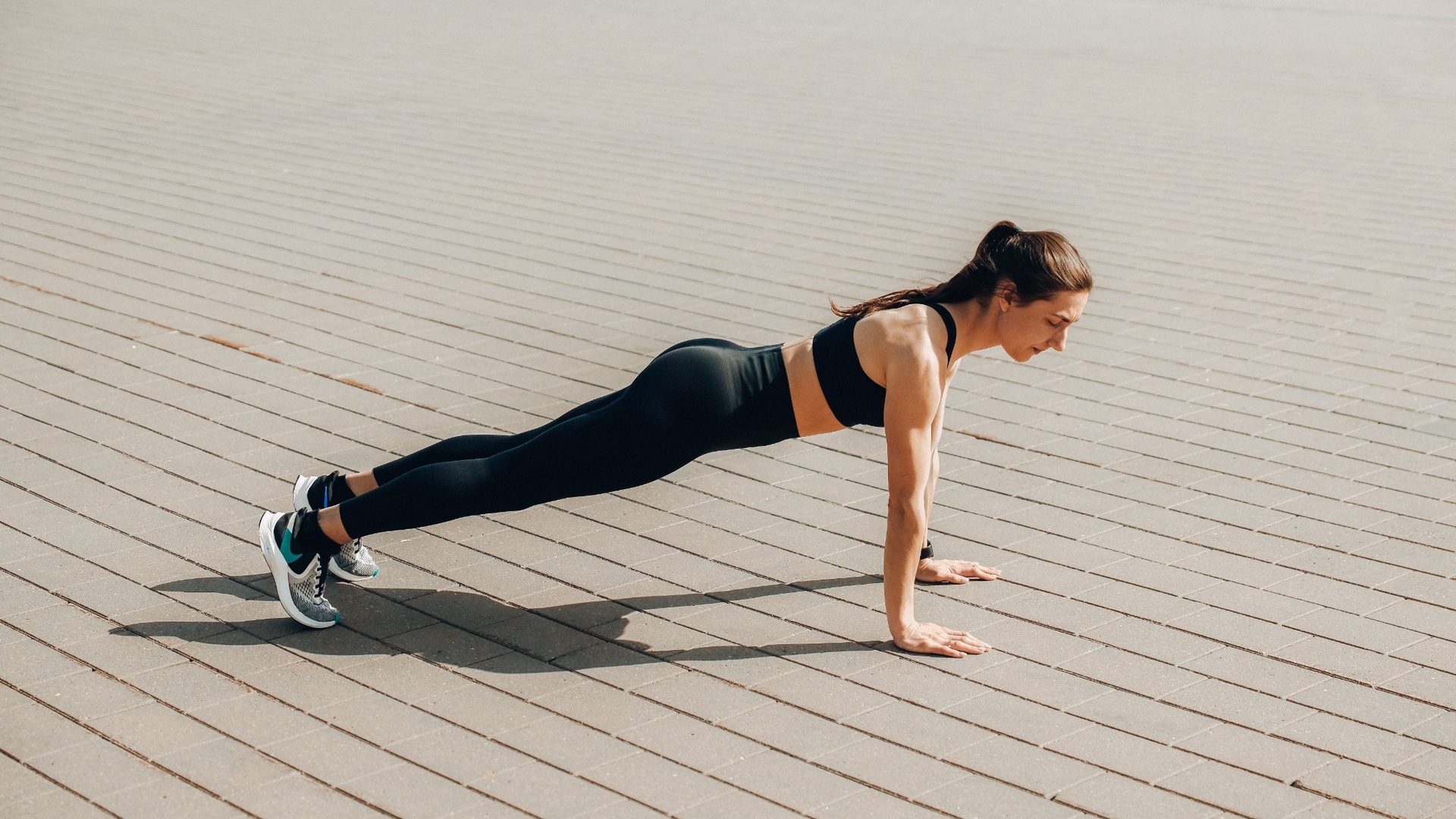
Jump both feet back together into a plank on your hands. Keep your shoulders roughly over your wrists and engage your abs and glutes. Try to keep a straight line from your head to your heels. Don’t lift your hips too high or let your lower back sag. If your lower back drops as soon as your feet move back, try stepping back one foot at a time instead.
3. Lower with a controlled push-up
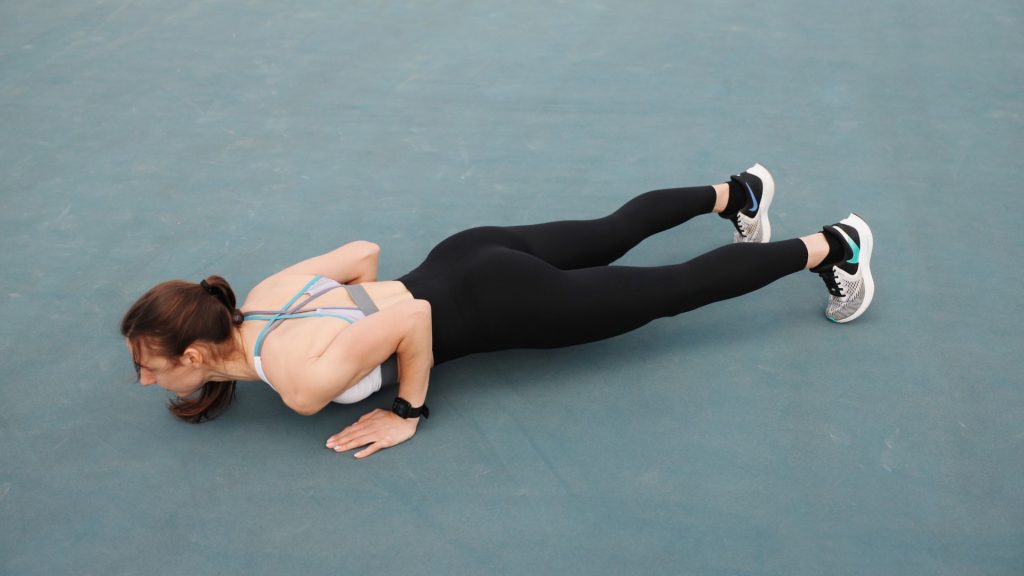
Bend your elbows and lower your chest toward the floor. Rather than flaring your elbows straight out to the sides, keep them angled slightly back. Your shoulders and hips should lower together. If you’re doing a chest-to-floor version, make that contact with control. Dropping onto your stomach and arching your back to get up might feel easier, but you lose control of your torso along the way.
Then push through your hands to rise. If you can’t do this part with control, start by leaving out the push-up and returning from the plank. If your chest rises while your hips stay on the floor, switch to an easier version.
4. Bring your feet forward
Jump your feet back toward your hands. Give yourself enough room to place them comfortably. Don’t force yourself into a stance that feels too narrow. Keep your knees pointing in the same direction as your feet. Make sure you aren’t losing your balance backward or sideways as you stand. If you feel cramped bringing your feet forward, or can’t control your lower back, step them in one at a time.
5. Stand up and add a small jump
Straighten your hips and knees to stand, then make a small vertical jump. No records need breaking here. You can reach your hands overhead; an overhead clap isn’t compulsory in every burpee variation. Land with control, letting your knees and hips bend slightly. Find your balance before the next rep. If your landing gets heavy or your knees cave inward, make the jump smaller. Leave it out altogether if needed.
What muscles do burpees work, and what are they good for?
Different muscle groups contribute at different points in a burpee:
| Muscle group | What it does |
|---|---|
| Quads and glutes | Help with squatting, standing up and jumping. |
| Calves | Work during the jump and landing. |
| Chest, triceps and shoulders | Provide the push in the push-up version and support you in the plank. |
| Abs and other core muscles | Stabilize your torso during the floor transition and plank. |
Burpees can add some full-body conditioning to a short workout. They also give you practice getting up from the floor, controlling your torso and moving between positions.
A small confession: I wasn’t a fan at first, but once you get the hang of the movement, there’s some fun to be had. Still, don’t think, “It works everything, so I don’t need any other exercises.” Burpees alone won’t replace a complete strength workout. They don’t adequately cover pulling movements, for example. If you want to build muscle, strength exercises that let you gradually increase the load have a separate role to play.
The version you choose matters too. Remove the push-up, and you reduce the pushing demand on your upper body. Remove the jump, and you reduce the landing impact. Think about your goal and what you can comfortably do right now, then choose your burpee variation.
How to make burpees easier for beginners
You don’t need to start with the hardest version on day one. You can step instead of jumping, leave out the push-up or simply stand up without a final jump. Starting with a version you can follow comfortably makes learning much easier.
Burpee without a push-up
Place your hands on the floor, move your feet back into a plank, then bring them forward and stand. Don’t lower your chest to the floor.
If you lose control during the push-up, this lets you practice the other parts of the movement. You can leave out the final jump too.
Stepping burpee
Instead of jumping your feet back, step one foot back and then the other. Step them forward one at a time to return to standing. This slows down the transitions and makes the movement easier to follow. You can alternate your leading leg rather than starting with the same one every time.
Burpee with your hands on a raised support
Instead of reaching down to the floor, place your hands on a stable bench or a sturdy countertop. Step your feet back one at a time, then bring them forward and stand. Your support must not slide or tip over. Stay away from a chair on wheels; you don’t want it rolling off halfway through the movement.
When should you make it harder?
First, make sure you can do a few balanced reps of your chosen version. If your last rep looks like your first, you’re keeping control of your torso and you aren’t experiencing pain, change one thing at a time: the rep count, transition speed, push-up or jump. Don’t add everything on the same day. That way, if it becomes too much, you’ll have a better idea of which change caused it.
What is the HYROX burpee broad jump?
You’ve decided to enter HYROX and you’re looking through the stations. Somewhere around the middle of the list, an exercise waves hello. Our dear friend, the burpee broad jump, is waiting at station four. So just as you finish your fourth run, increasingly out of breath, there it is, welcoming you with all its love and affection. The target is 80 meters. After each burpee, you jump forward rather than upward.
If you’re curious about how the race works, take a look at our What is HYROX? article.
Key rules for a valid rep
This summary is based on the 2026/27 HYROX Singles rulebook:
- On the first burpee of each section, your hands must be behind the start line.
- Your chest must clearly touch the floor at nipple level.
- You may step or jump into and out of the burpee, and use a knee when rising.
- Your feet must not pass your fingertips as you rise.
- On subsequent burpees, place the bases of your palms no more than 30 cm ahead of your front toes. Don’t move your hands forward once placed.
- Both feet must take off and land simultaneously during the broad jump, with no more than 5 cm difference between their front edges.
- No extra steps or shuffles to advance.
- You choose your jump distance.
- Both feet must fully cross each section’s end line. Restart each section in the required starting position.
- Landing on the finish line requires another burpee broad jump.
- The first infringement earns a warning; the second and each subsequent infringement add a 15-second penalty.
Before racing, also check the current rulebook for your division and the athlete briefing.
How to find a pace you can sustain
You’ll see athletes on Reels or in race videos making huge jumps and flying through this station. It’s hard not to be a little jealous. Especially if you’re out of breath after two or three reps.
But there’s a trade-off: if you need a long recovery after a big jump, the distance you gain might not make up for the time you lose.
Try two approaches in training. In one, use shorter, steady jumps. In the other, jump a little farther while staying in control. Over the same short distance, compare your time, breathing and final reps. Which approach leaves you less of a mess? Look for a rhythm you can still maintain toward the end. Height, mobility, strength and conditioning all differ, so there’s no need for everyone to aim for the same jump distance.
First, see whether stepping up or jumping up feels more comfortable while you’re fresh. Then try the same technique after a short run. Seeing what changes when you’re tired may teach you more than just doing fast reps while fresh. Practice within the race rules. If you get used to taking an extra step after every rep in training, dropping that habit on race day might be harder than you think.
Common burpee mistakes
Letting your lower back sag in the plank
Losing control of your torso as you jump your feet back can happen, especially when you pick up the pace. What can you do? Slow down the transition, engage your abs and glutes, and return to the stepping version. Raising your hands onto a stable support can help too.
Letting your knees cave inward on landing
If your knees noticeably collapse inward or you lose your balance at the end of the jump, that rep may be getting too demanding. What can you do? Jump a little lower, keep your knees pointing in the same direction as your feet and control the landing. Practice without the jump if needed.
Dropping your chest and arching your back to get up
Losing control during the push-up and lifting your upper body first is a common way to rush through a burpee. What can you do? Practice push-ups separately or leave this stage out for now. Choose an easier version you can do properly rather than losing control in the harder one.
Holding your breath
It’s easy to forget to breathe when you’re concentrating on the movement. A few reps later, it feels like someone has switched off the gym’s oxygen supply. What can you do? Keep breathing throughout the movement. You can try exhaling as you push up or stand. There isn’t one breathing pattern that suits everyone. The important thing is not to hold your breath for long stretches.
Chasing reps while your form falls apart
Just because the program says 10 doesn’t mean you have to squeeze out three more reps after you’ve lost control. What can you do? End the set or switch to an easier version. If your technique is falling apart toward the end, reduce the rep count in your next set.
For pacing and technique mistakes during HYROX preparation, take a look at our guide to the most common HYROX mistakes.
How to fit burpees into your weekly training
Treat the examples below as starting points. How many burpees you do depends on your current workouts, the version you choose and how well you recover. A tiring burpee block before your main strength session may affect the quality of the exercises that follow. If you’re learning the technique, practice a few reps after warming up, while you’re still fresh. For conditioning, you can set aside a short block at the end of your workout.
For beginners
You could start with this on two separate days each week:
- 2 sets of 3–5 stepping burpees, without a push-up or jump.
- Rest for 60–90 seconds between sets, or longer if needed.
- Leave at least one day between sessions.
If the final reps are still controlled, add a third set or a few extra reps first. You don’t need a speed target at this stage.
If you already know the movement
For a short conditioning block, try 3 sets of 5–8 reps. Start with 60–90 seconds of rest between sets and extend that if needed.
If you also have hard running sessions or jumping workouts that week, adjust your burpee volume accordingly. A few sets might not look like much on the program. Tomorrow’s stairs may change your mind.
Burpees in an EMOM
EMOM means “every minute on the minute”: you do the assigned work at the start of each minute, then rest for the time remaining. For example, you could do 3–5 controlled burpees at the start of each minute for 6 minutes. You should have time left to rest after your reps. If the work fills the entire minute, reduce the rep count or choose an easier version.
Burpees in a Tabata-style workout
The commonly used Tabata timing is 20 seconds of work followed by 10 seconds of rest, repeated for eight rounds. But applying those timings to burpees doesn’t automatically mean you’re matching the intensity of the original Tabata protocol. For beginners, 10 seconds of rest may also be too little.
Get comfortable with the technique before moving to this format. A few rounds of 15–20 seconds of controlled work followed by 40–60 seconds of rest may be more manageable at first.
If you’re training for HYROX
Once your technique is comfortable, you could try 3 sets of 5–10 meters of burpee broad jumps. Between sets, rest until your breathing settles and you can perform the movement with control again. Later, combine this with a short, easy run. Don’t increase the distance, running pace and number of sets all at once. To work on another station as well, take a look at our farmer’s carry technique guide.
Make peace with burpees, one rep at a time
You don’t need to do more reps every session to see improvement. If you’re lowering with more control, keeping your lower back steady and getting up with good balance on the final rep, you’re making progress. Start with a version that suits you. Once you have control, increase the reps or difficulty. If HYROX is your goal, add the race standards and a forward-jump rhythm you can sustain.
I’m still not completely over my dislike of burpees. You don’t need to break the gym’s burpee record on day one either. Leaving with enough in the tank to train again tomorrow is a perfectly good result.
Frequently asked questions
How many burpees should you do a day?
There isn’t a daily number that works for everyone. A few short sets of controlled reps can be enough to get a beginner started. You don’t have to do them every day. Don’t just ask, “How many can I get through?” The quality of your final rep and whether you recover before your next workout matter too.
Can burpees help you lose weight?
Burpees can contribute to your energy expenditure. But weight loss needs to be considered alongside your eating habits and total daily activity. Burpees alone don’t guarantee a particular amount of weight loss. The CDC also considers physical activity together with diet when discussing weight loss. Walking, cycling or another activity you can keep doing regularly can help too. You don’t have to do burpees to lose weight.
Do burpees burn belly fat?
Your abs help stabilize your torso during a burpee. That doesn’t mean the exercise specifically burns fat from your stomach. Rather than adding reps just to “burn belly fat,” look at your eating habits and overall activity.
How many calories does one burpee burn?
There isn’t one reliable number. Your body weight, pace, burpee variation, workout duration and rest periods all affect the result. Don’t treat “100 burpees burn this many calories” charts as precise calculations.
Can you do burpees without push-ups?
Yes. Burpees without push-ups can be used in general training. If you’re entering a competition, check the organizer’s movement standards separately.
What should you do if burpees hurt your wrists or lower back?
Don’t push through pain just to finish the set. Stop, check your technique and consider whether you’re using an appropriate version. For recurring or persistent pain, get advice from a healthcare professional. Don’t assume that raising your hands onto a support will necessarily solve the pain.