
What Are Sandbag Lunges? HYROX Weights, Technique and Race Preparation
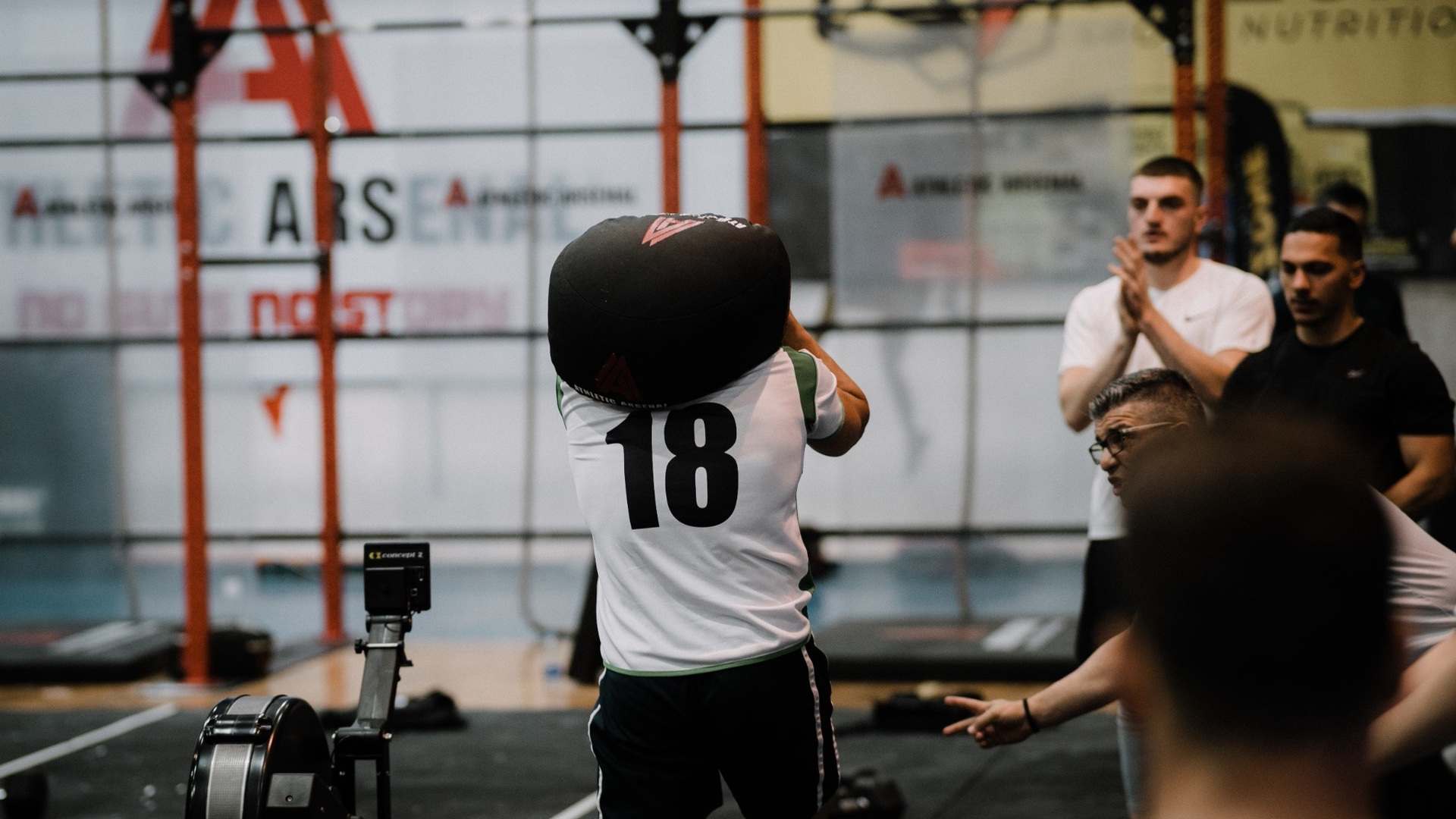
On a HYROX course, 100 metres might not look like much. Put a sandbag on your shoulders and start lunging, though, and you might change your mind. By the time you get here, you’ve already run seven kilometres and completed six stations. That’s what makes Sandbag Lunges tricky. A movement you might practise on fresh legs at the gym now has to keep going on tired ones. You’re trying to stay balanced while getting your breathing under control. And you still have the final run and Wall Balls ahead of you.
So what exactly do you need to do at this station? How heavy is the bag in your division, how should you adjust your stride, and what can you work on in training to make it more manageable?
What are Sandbag Lunges, and which muscles do they work?
A sandbag lunge is a lunge performed with a sandbag. In HYROX, you carry the bag across your shoulders and move forward by alternating legs, lowering into each lunge and standing back up. It’s a weighted version of the walking lunge.
Your quads and glutes do much of the work as you rise. Your hamstrings also contribute, while your core muscles help you maintain your posture and balance under the load. With a different leg leading each step, you need to control both sides individually.
Carrying the bag on your shoulders changes how the movement feels. You might be used to lunging with dumbbells in your hands, but having the weight higher up is different. You’ll notice it if the bag shifts, your torso tips forward or your feet end up too close together. That’s why preparing for this station involves more than seeing how much weight your legs can handle.
How far are HYROX Sandbag Lunges, and how heavy is the bag?
Sandbag Lunges are the seventh station in the race. The distance is 100 metres, with the weight depending on your division. Here are the standard Singles weights for the 2026/27 season.[1]
| Division | Sandbag weight | Distance |
|---|---|---|
| Women Open | 10 kg | 100 m |
| Men Open | 20 kg | 100 m |
| Women Pro | 20 kg | 100 m |
| Men Pro | 30 kg | 100 m |
You’re not aiming for a fixed number of repetitions here. You have a distance to cover. How many lunges that takes depends on your stride length.
It’s tempting to think, “I’ll just take longer steps and get it over with.” But how easily you can stand up from each lunge matters just as much as how far it takes you. If you lose your balance on every rep, doing fewer of them might not give you the advantage you expected.
How to do Sandbag Lunges
Position the bag on your shoulders
Start by positioning the bag evenly across both shoulders. Make sure the weight isn’t all on one side, it isn’t pressing against your throat, and you can hold it securely with your hands. If you already feel the need to keep adjusting it before you’ve started, sort out its position first. Practise getting the bag onto your shoulders and lowering it under control afterwards, too. Training only the lunges and leaving your first attempt at shouldering the bag until race day is a surprise you can do without.
Stepping, lowering and standing up
As you step forward, don’t place your feet directly in line as if you’re walking a tightrope. Leave enough width to move without wobbling from side to side. Then bend both knees and lower yourself, bringing your rear knee into clear, controlled contact with the floor. The contact needs to be visible; you don’t need to slam your knee down.
Push through your front foot to stand up. Pay attention to whether your front heel lifts noticeably, your knee collapses inward or the bag pulls you forward. If any of those happen, reassess your stride or the load before trying to go faster.
Finish standing up at the top before moving into the next lunge with the other leg. If continuous lunges suit you, you can practise that way. If you need a moment between reps, take the time to settle your stance.
How do you find the right stride length?
There’s no single measurement in centimetres that works for everyone. Your leg length, range of motion and load may all be different.
In training, try covering the same short distance a few times with slightly different stride lengths. Which one leaves you wobbling less? Which makes it harder to stand up? Can you move as well on the last rep as you did on the first?
If possible, film a short clip from the side and the front. You might feel as though you’re standing fully upright, only to see that you’re cutting the top of the movement short. That’s one of those details that can be difficult to spot by feel alone.
Sandbag Lunge rules to know before your race
These are the basic movement standards:[1]
- Start with both feet behind the line.
- Your rear knee must clearly touch the floor on every rep.
- Finish each rep with your knees and hips fully extended.
- Alternate legs, without adding walking steps or shuffling between reps.
- You may stop with both feet parallel.
- The bag must be supported across both shoulders. Placing it on another surface to take the load off results in a 15-second penalty for each infringement.
- At the end of each lane, your leading foot must completely cross the line. After turning, start the next section with both feet behind the line.
- Return the bag to the marked area when you finish the station.
Resting is where things can get confusing. Being allowed to stop doesn’t mean you can put the bag down for a break. How you’ll rest is something to think about during your preparation, too.
These are the basics. Before your event, check the latest rulebook and athlete briefing, and familiarise yourself with the turns on the course.
Why can this station feel harder than you expected?
It’s easy to do a few metres of lunges at the gym and think, “I’ve got this.” In HYROX, the same movement comes near the end of the race. The fatigue from the earlier runs and stations is still there when you pick up the bag. You also keep carrying the load. Even when you stop to give your legs a breather, the bag stays on your shoulders. So the number of reps you can do without stopping doesn’t tell the whole story.
As you get tired, small changes can creep in: not lowering quite as far, starting the next step before you’ve stood up fully, or constantly shifting the bag from one shoulder to the other. If you notice these, slow down and tidy up your movement. When you’re preparing for a race, try not to make a habit of practising faulty reps. Don’t treat muscle fatigue and sharp joint pain as the same thing, either. If you feel pain in your knee, hip or lower back, don’t keep pushing simply to finish the distance.
How should you pace Sandbag Lunges in a race?
It can be tempting to keep up with everyone around you over the first few metres. But the person beside you may have a different stride, load and level of race experience. Rather than copying their pace, start with an approach you’ve had a chance to test in training. When assessing your pace, don’t look only at your Sandbag Lunge time. If you get through the station quickly but need a long recovery before you can run again, that pace may be too much for you.
Try a run after your lunges
To get a feel for this in training, you could try a short, easy run after your lunges. Notice how those first steps feel and how long it takes to settle your breathing. That can tell you more about choosing a race pace than the station time alone.
If you need a break, you don’t have to wait until it’s your only option. Find out in training whether short pauses or slower, continuous movement work better for you. There’s no universally correct answer to “How many steps should I take before stopping?”
How do you split Sandbag Lunges in Doubles?
In Doubles, 100 metres is the team’s total distance. The bag weighs 10 kg for Women Open; 20 kg for Men Open, Mixed and Women Pro; and 30 kg for Men Pro.[2]
During a changeover, the bag cannot be passed forward. It may be passed sideways or backwards. The resting partner must stay behind the working athlete and must not obstruct other racers.[2]
Don’t automatically assume you need to split the work equally. One of you may be more comfortable with this movement. But having the stronger partner take a very long section and then struggle on the next run may not help the team either.
Try different ways of sharing the work in training. Agree on how you’ll decide when to swap, too: after a set section, or when the working partner calls for it? A short signal you’ve agreed on beforehand may be more useful than a long explanation in a noisy race venue.
Practise the handover separately as well. Being good at lunges individually doesn’t necessarily mean you’ll be comfortable transferring the load between you.
Where should you start with Sandbag Lunge training?
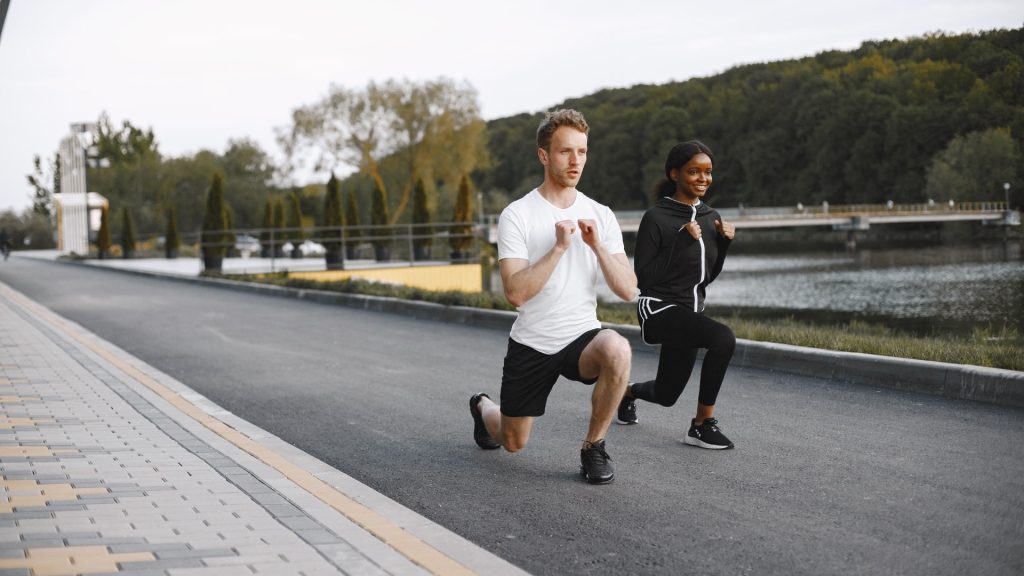
If you’re new to the movement, race weight doesn’t have to be your first target. Learn to balance, lower yourself and stand up during bodyweight walking lunges. Then move on to short distances with a light bag.
For example, mark out a short, measured lane and notice how your movement changes on each pass. Knowing the distance gives you something different to work with than simply counting reps. It also lets you see whether your steps get shorter towards the end of the effort.
Avoid increasing the total distance at the same time as you make the bag heavier. First, see that you can manage your current work comfortably; then make the next adjustment. Don’t measure progress only by the weight you carry. Wobbling less with the same load, or still standing up fully in the final section, counts as progress too.
Combining running and lunges
Once your technique is established, you can combine running and lunges. Keep both sections short and manageable to begin with. What you’re learning here is how you position the bag and start those first few steps when you’re already breathing harder.
What if you don’t have a sandbag?
Bodyweight or dumbbell lunges can be part of your preparation. Just don’t treat them as an exact substitute for the race equipment. With dumbbells in your hands, the position of the load and the grip demands are different.
If you’re entering a race, it’s worth finding an opportunity to train with a sandbag at some point. You’ll get to know how it sits on your shoulders, how to keep it secure and what changes when you get tired. That doesn’t mean you need to buy equipment on day one. Check whether your gym has a suitable bag or whether you can access a training space with HYROX equipment.
For your first attempts, pay attention to your movement before reaching for the stopwatch. Once you can cover a short distance with good form, it becomes easier to decide what to increase in your next session.
Sources
Rules checked: 24 October 2026. Race information is based on the HYROX 2026/27 rulebooks. The technique and training sections offer general practical guidance, not an individual training programme.
- HYROX Singles Rulebook 2026/27 — section 8.7
- HYROX Doubles Rulebook 2026/27 — section 8.7
Frequently asked questions
Is the Sled Push only a leg exercise?
Your legs play a major role in the push, while your torso and upper body help maintain your connection with the handles. Don’t focus on leg strength so much that you overlook your position.
What should I do if the sled won’t move?
In training, check the total load, whether your feet are slipping and how you are positioned. Reducing the load and trying again is a more useful starting point than pushing harder with the same poor form. During a race, tell the judge if you think there is an equipment issue.
What is a good Sled Push time?
A single target is not particularly useful without knowing your division, surface, experience and pace through the rest of the race. Start by comparing your own attempts under similar conditions. Alongside your time, track your breaks and how easily you settle into the next run.
What kind of shoes work best?
Don’t choose on running comfort alone. Test how well they grip during sled pushes and whether your feet stay secure inside them. Race day should not be the first time your race shoes meet a sled.