
SUP paddle technique: why does paddling the wrong way wreck your back?

Today we’re going to take a closer look at SUP paddle technique.
With the arrival of summer, SUP has become a sport you see around you more and more often. Plenty of us have either tried it already or are planning to. First of all, I want to say that this is a great thing. You’re doing an activity that’s good for you both physically and mentally, so congratulations in advance.
But most people buy a SUP and start paddling straight away without any lessons. There’s really nothing wrong with that. If your paddling technique is wrong, though, you could be hurting yourself without realising it.
Think back to your first time on a SUP. You climb onto the board, find your balance and start paddling. “Right,” you tell yourself, “I’m a SUP paddler now.” But a few minutes later your lower back and upper back start to burn. Chances are this thought crosses your mind: “So SUP is more tiring than I expected.”
I’ve got a bit of news for you. Paddling is tiring, of course. But the pain you’re feeling most likely isn’t down to the sport itself; it’s down to poor paddle technique. Bad technique doesn’t just hold back your performance. In the long run, it can also lead to lower back, upper back and shoulder pain. The good news is that most of these mistakes can be fixed with a few small technical adjustments.
Here are the most common mistakes. See whether you’re making any of them.
Why does good paddle technique matter so much?
“How hard can paddling be?” you might think. After all, you take the paddle, put it in the water and push yourself forward. At first glance, it really does look that simple.
But the more you get into it, the more you realise it isn’t a movement powered by your arms alone. With good paddle technique, your arms aren’t the only thing working. The real work is done by:
- Your abdominal muscles,
- Your back muscles,
- Your hips,
- Your legs,
- Torso rotation
all working together. In other words, what moves you forward isn’t strong arms but your whole body working in harmony. The same principle applies in rowing too.
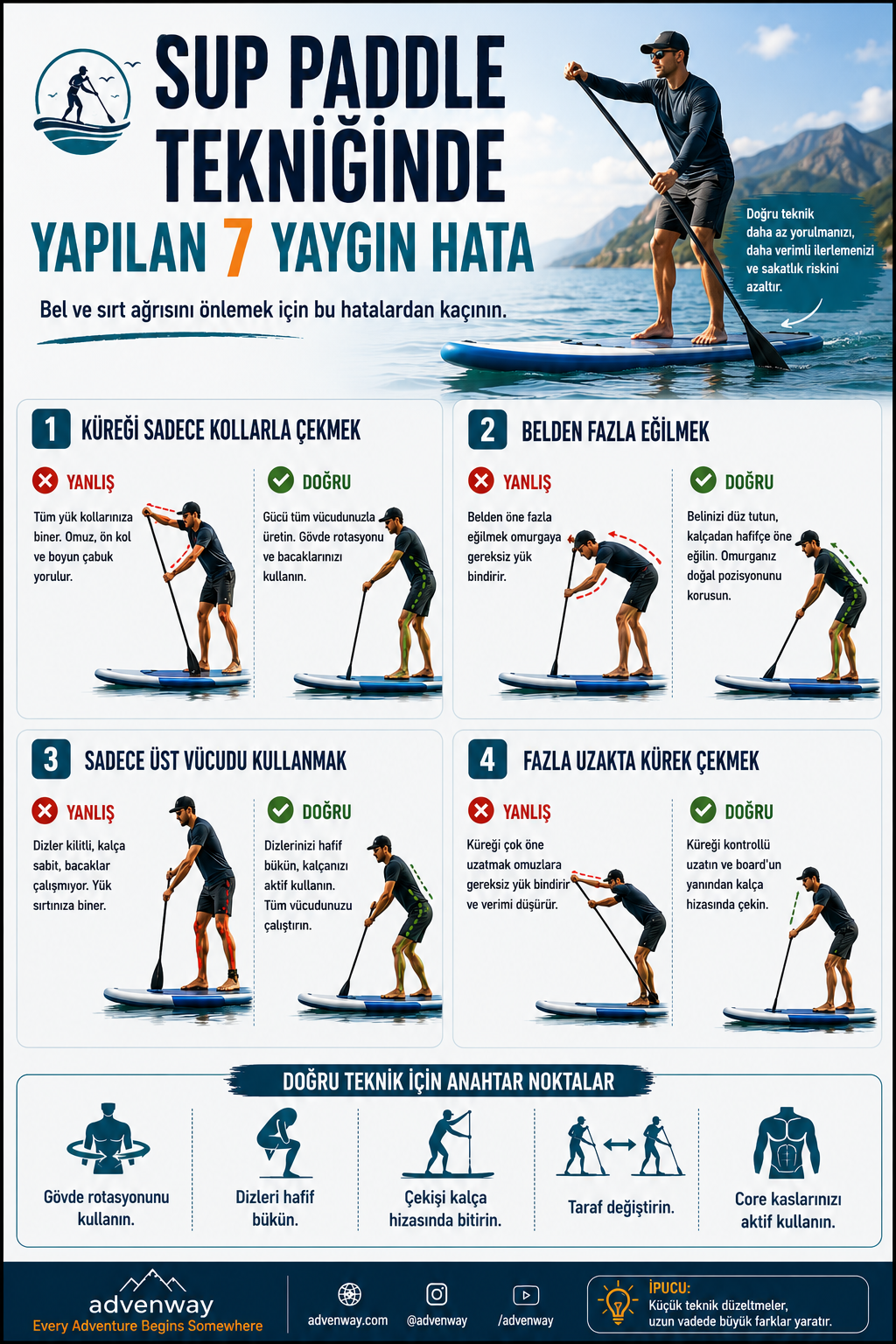
The 7 most common paddle technique mistakes
1. Paddling with your arms only
This is the biggest mistake beginners make. They try to pull the paddle using nothing but their arm muscles. You might not notice it for the first few minutes. But before long:
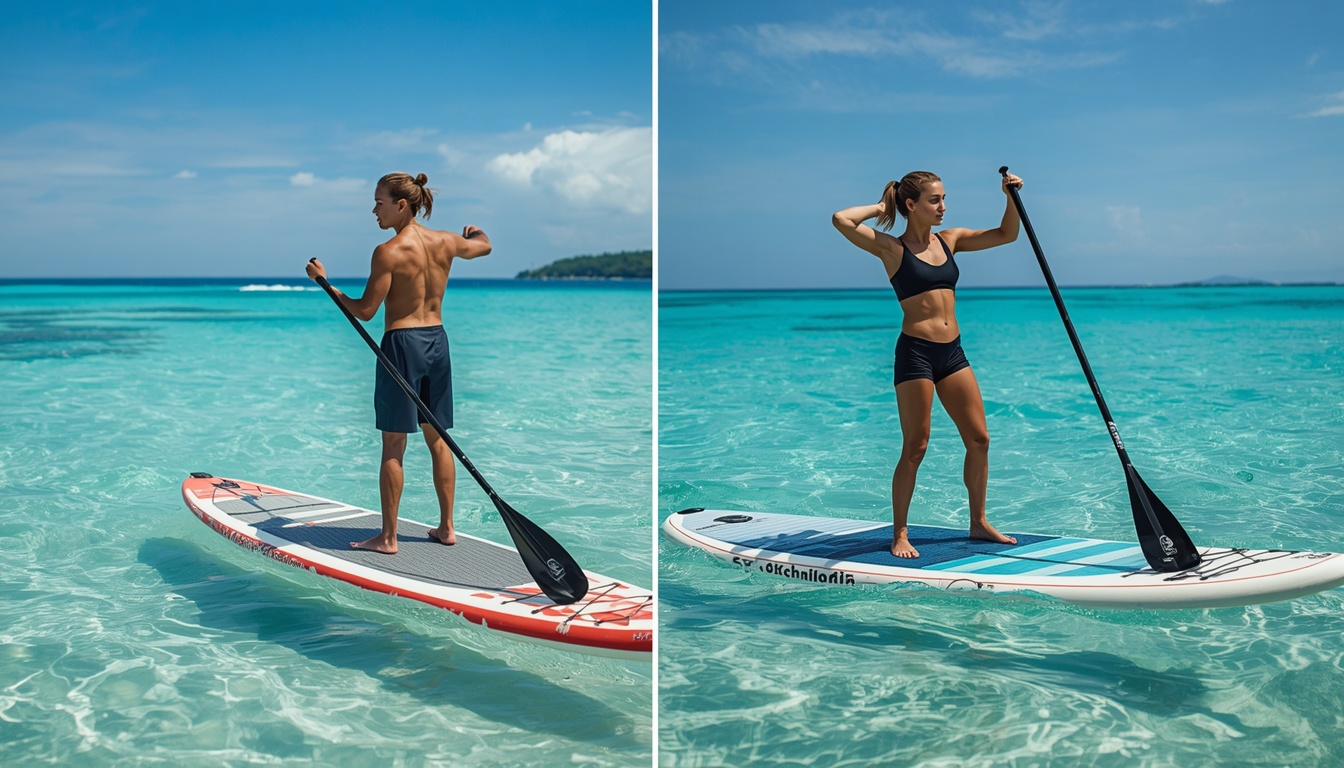
- Your shoulders start to burn,
- Your forearms get tired,
- Your neck tenses up,
- Your back begins to ache
and that’s because, instead of using your big muscle groups, you’ve left all the load to the small ones. As you can imagine, that’s not something you can keep up for long.
2. Bending too much at the waist
If it’s your lower back and upper back in particular that hurt, the reason is most likely that you’re leaning too far forward. Some people keep bending at the waist without realising it, just to reach the paddle a little further out.
But with every stroke you’re putting unnecessary load on your spine. The right way is to hinge slightly forward from the hips instead of bending at the waist. Your spine should stay in its natural position as much as possible.
3. Using only your upper body
SUP is actually a true full-body sport. Most of us don’t even realise it. Knees completely locked… Hips fixed… Legs doing almost nothing… When that happens, all the load ends up on your lower back and upper back again. Slightly bent knees, on the other hand, improve your balance and absorb the bumps, which takes load off your body.
4. Reaching too far
You might think that stretching the paddle as far forward as possible will give you more power. In fact, the opposite happens. This movement puts unnecessary load on your shoulders. The ideal is to reach forward in a controlled way and pull the paddle past the side of the board, back to your hips. Carrying on with the stroke once the paddle has passed your hips doesn’t give you any extra speed. If anything, it makes you use up more energy.
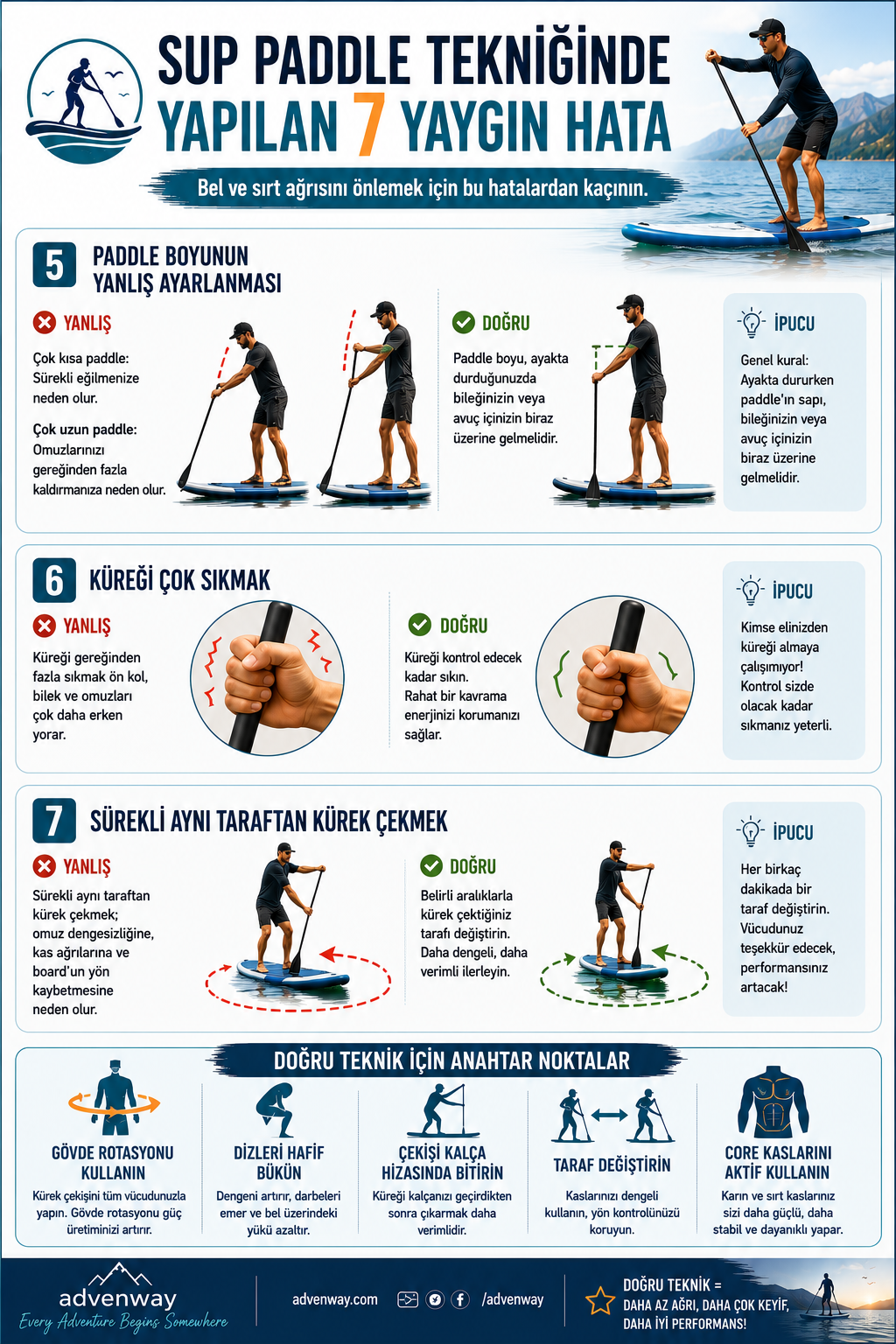
5. Setting the wrong paddle length
If you’re buying a paddle yourself, make sure you choose the right length. If you’re buying from a shop, don’t hesitate to ask the staff for help. Paddle length matters far more than you’d think. A paddle that’s too short will keep you bending over, while one that’s too long will make you lift your shoulders more than you need to.
As a general rule, the paddle is set so that, when you’re standing, it comes a little above your wrist or palm. That said, this can vary depending on the discipline.
6. Gripping the paddle too hard
I think most beginners do this without meaning to. They hold the paddle in a death grip, as if it’ll slip out of their hands the moment they relax a little. Honestly, folks, you don’t need to squeeze it that hard. Say the paddle does fall in the water. Unless there’s a strong current or waves, you’ll most likely be able to get it back easily.
If you grip the paddle harder than you need to, your forearm muscles, wrists and shoulders will tire much sooner. In short, you only need to hold it tightly enough to control it. Don’t worry, nobody’s trying to take the paddle off you.
7. Always paddling on the same side
This mistake is far more common than you’d think. Many of us paddle on the same side all the time without even noticing. As a result:
- One shoulder works harder than the other.
- One side of your torso carries more of the load.
- The board keeps trying to change direction.
To move more efficiently and use your muscles evenly, you need to switch the side you paddle on at regular intervals. It may look like a small habit, but on longer paddles it makes a much bigger difference than you’d imagine.
How does good paddle technique reduce back pain?
With good paddle technique, the load doesn’t fall on just one area. Think of it with a simple everyday example.
You’ve got two heavy shopping bags and you’re carrying both in one hand. However strong you are, your arm gets tired after a while. Then your shoulder and neck start to burn.
So what happens if you split the same weight evenly between both hands? It becomes much easier to carry. That’s exactly the logic behind SUP.
Instead of putting the load on one area, you need to spread it across your whole body. With good paddle technique:
- Body rotation comes into play.
- Your abdominal muscles stabilise your torso.
- Your hips support the movement.
- Your legs keep you balanced.
- Your back muscles complete the movement.
That way, the load on your lower back and upper back drops significantly.
Strength or technique?
Being strong is an advantage, of course. But if you ask me, technique matters far more.
Powerful strokes with bad technique don’t just tire you out faster; they also raise your risk of injury.
Someone with good technique, on the other hand, can paddle for longer while using much less energy. So in the early stages, focus on improving your technique, not your speed. The speed will come naturally as a result.
Focus on these in your first lessons
If you’re new to SUP, don’t try to go fast at first. Start by:
- Working on your balance.
- Setting your paddle to the right length.
- Learning torso rotation.
- Not locking your knees.
- Making switching sides a habit.
Get these right and you’ll tire less and start enjoying your paddling far more.
How would I learn paddle technique?
If it were me, I’d go for one of two approaches.
The first option would be to go to a water sports club and take a basic SUP course. The lessons don’t take very long anyway. You can learn the right technique in a short time. For me, it’s also the safest and quickest way.
The second option, if I were trying to teach myself, would be to watch videos by instructors. There are plenty of instructors online making genuinely good content.
But I wouldn’t rely on just one video. I’d watch what several different instructors have to say and pay particular attention to the points they all agree on. Even so, my first choice would always be lessons with an experienced instructor. That’s because fixing a movement you’ve taught yourself wrong is much harder than learning it properly from the start.
The bottom line: why does good paddle technique make a difference?
A sore lower back or upper back the day after SUP isn’t always normal. We usually put it down to a lack of fitness. But the real problem may be poor paddle technique. With good technique:
- You get less tired.
- You move more efficiently.
- You can paddle for longer.
- You significantly reduce your chances of lower back and upper back pain.
Remember… In SUP, being strong doesn’t always mean going faster. Good technique, though, opens the door to paddling that’s more enjoyable and much healthier too. Before your next paddle, ask yourself this:
Am I really paddling the right way?
Perhaps the biggest change that will boost your performance isn’t paddling harder but learning to paddle properly. And finally, one small piece of advice… If you’ve never tried SUP, give it a go at the first chance you get. You might struggle to keep your balance for the first few minutes. Falling in a few times is perfectly normal, too.
But once you experience that first moment of gliding comfortably along on the board, you’ll understand why this has become one of the most popular water sports of recent years. I do have one small request, though. On beaches, especially in the summer months, SUP traffic gets seriously busy. For your own safety and for the safety of other paddlers, don’t forget to keep an eye on what’s around you and to follow the basic rules.
Believe me, a SUP session done with good technique is a whole different experience. For guides to SUP, rowing and other water sports, have a look at our Water Sports category.