
When should you replace your running shoes? How many kilometres do they last?

You bought a pair of running shoes, put hundreds of kilometres on them, and eventually found yourself wondering: “How much longer have these got left?” Search online and things get a little more confusing. You’ll see 500, 600, 700 and 800 kilometres mentioned. Say you’ve already reached one of those numbers. Now comes the next question: “So… do I need to replace them?”
No. You don’t have to retire your shoes just because they’ve passed a certain distance. Working out how long a running shoe lasts isn’t quite that simple. Even different models from the same brand can vary considerably in durability. Construction, foam, running form, surface, how you use the shoes and the load they’re put under all play a part. That’s why distance alone doesn’t tell the whole story.
How many kilometres do running shoes last?
The range you’ll see most often is around 500–800 kilometres. ASICS also suggests considering replacement at 300–500 miles, or roughly 480–800 kilometres. But the brand makes it clear that this isn’t a fixed expiry date. Running surfaces, the runner’s build and running style all affect wear.
Some shoes may still feel perfectly good after 700 kilometres, while others lose their familiar feel much earlier.
It helps to treat distance as a reminder to check your shoes, rather than a use-by date. Once your pair passes 500 kilometres, for example, “I should take a closer look at these” is a better response than “I need to replace them now.”
Where does the 500–800 kilometre guideline come from?
Researchers have been looking at how the mechanical properties of running shoes change with use for a long time. Laboratory studies from the 1980s found that shock absorption changed as shoes were used, and that there were already substantial differences between shoes before testing began. More recent research also suggests that midsole materials can play an important role in durability.
For example, we can’t expect EVA, different polyurethane foams and newer foam materials to behave in exactly the same way after hundreds of kilometres. The key point is that not every foam ages the same way. So putting a single distance limit on every running shoe doesn’t really make sense.
What determines how long running shoes last?
Give the same running shoe model to two different runners, and you shouldn’t expect both pairs to wear out at exactly the same distance.
The runner’s weight
The load a shoe takes with each step varies from runner to runner. That can affect how the midsole and other materials behave over time. But it doesn’t automatically mean that heavier runners must replace their shoes sooner. It may simply make sense to keep a closer eye on the shoe’s condition and how it feels, alongside its distance. Weight isn’t the only factor, either; it needs to be considered together with the others.
Running form
Landing mainly on your heel, midfoot or forefoot can make different parts of the outsole wear faster. One runner might quickly wear down the outside of the heel, while another puts much more wear on the forefoot of the very same model. A look underneath your shoes will usually show where the wear is concentrated. If you’re unsure about the terminology, our article on the differences between pronation, supination and a neutral gait may help.
The surface you run on
Rough asphalt, concrete, a synthetic running track and a treadmill don’t wear down an outsole in the same way. If you’re always running on hard, abrasive surfaces, the outsole rubber may wear faster. You shouldn’t expect trail running and treadmill running to leave the same wear patterns, either.
The shoes themselves
This may be one of the biggest variables. A durable daily trainer with plenty of outsole rubber and a lightweight racing shoe designed to save every gram are unlikely to have the same lifespan. If you’re curious about differences in sole construction, our article on stack height goes into more detail. When comparing how far shoes last, it makes more sense to compare models designed for similar uses.
How can you tell your shoes are worn out if you don’t track distance?
If you log your shoe distance in Strava, Garmin Connect or another app, things are a little easier. But you don’t need an app to keep an eye on your shoes. They give you a few clues of their own.
1. The outsole is significantly worn
Start by looking underneath the shoe. It’s completely normal for the tread pattern to fade over time. Your shoes have been hitting the ground for hundreds of kilometres, so they’re hardly going to look exactly as they did on day one. But if the rubber has worn away completely and the softer midsole foam underneath is showing, that’s a different matter. ASICS also lists an outsole worn through to the midsole as a sign that replacement may be worth considering.
Don’t overlook a loss of grip, especially if you run in the rain or on wet surfaces. A shoe can still feel soft underfoot while offering considerably less traction.
2. The midsole has permanently changed shape
The midsole does a lot of the work in a running shoe, but many of us focus only on the outsole rubber when we inspect a pair. The foam compresses with every step, then tries to return to its original shape. So it’s normal to see wrinkles or lines along the sides over time. Those alone don’t mean your shoes are finished.
However, if the foam has noticeably collapsed, there’s a substantial difference in height between the two sides, or the shoe no longer sits level on a flat surface, it deserves a closer look. These can be signs of more advanced wear.
3. The wear is heavily concentrated on one side
The two sides of a shoe don’t have to wear at exactly the same rate. But if one section of the sole has collapsed while the other still looks almost intact, the way the shoe sits on the ground can change over time. A 2011 study using running shoes with around 200 miles, or 322 kilometres, of wear found some changes in running biomechanics. The researchers also emphasised that most of those changes were small.
So it isn’t right to look at a worn shoe and automatically conclude that it will cause an injury. Equally, obvious and severe uneven wear isn’t something to ignore.
4. The shoes don’t feel like they used to
This one is a little more personal. After hundreds of kilometres in the same pair, it’s easy to forget how they felt when you first bought them. Over time, you might notice that:
- landings feel harsher;
- the shoes don’t feel as lively or responsive;
- the sole feels flatter or less springy;
- unfamiliar discomfort appears after a run.
These can be reasons to inspect your shoes more closely. But there’s an important distinction here: old shoes aren’t the cause of every new ache. Increased training volume, recovery, running surface and pace can all play a part. “My knee hurts, so my shoes must be worn out” is too simple a conclusion. If pain persists or is severe, there may be more to address than just replacing your shoes.
If running shoes still look new, is the sole in good condition too?
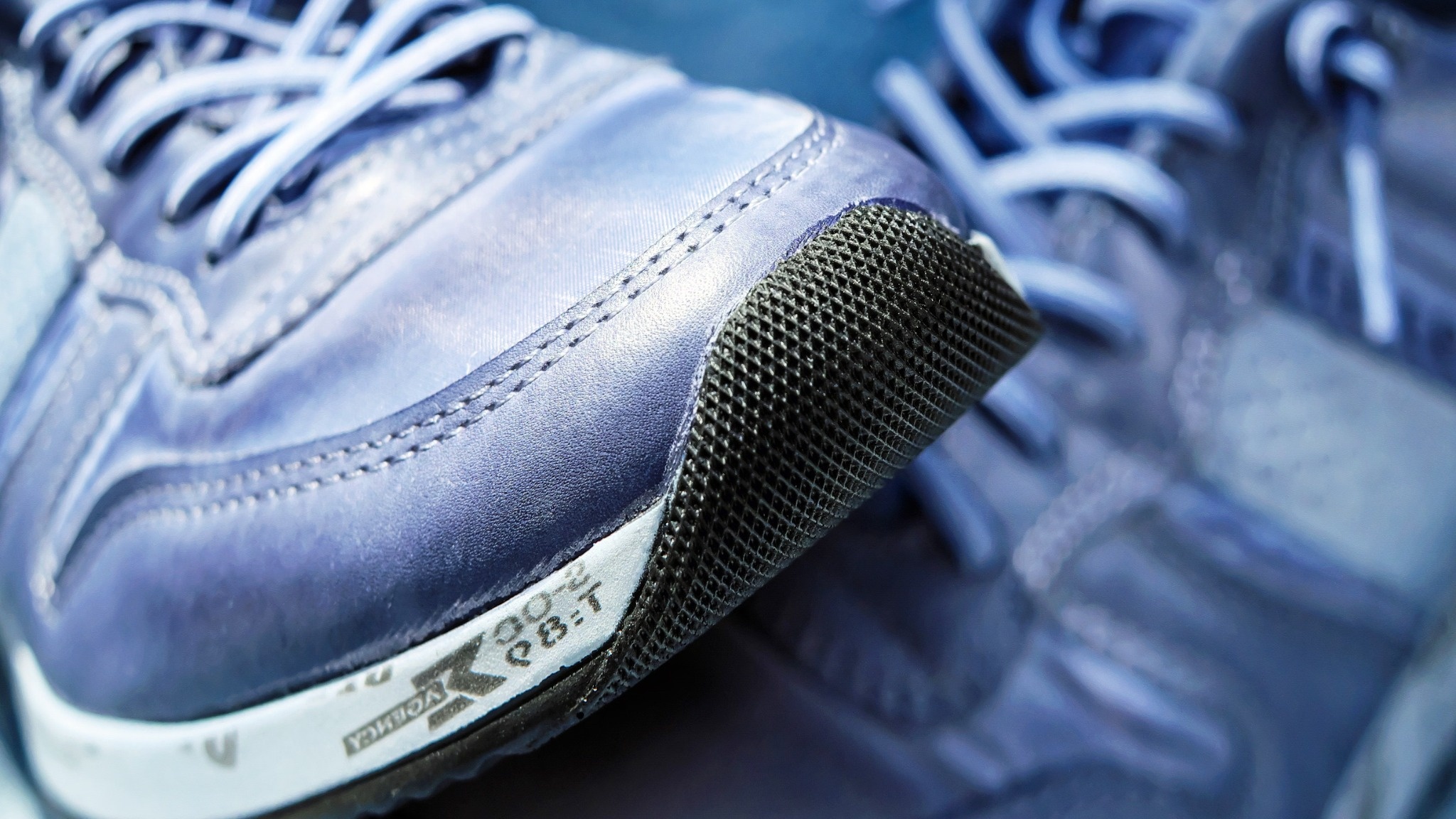
Not necessarily. This is one of the slightly misleading things about running shoes. If you take good care of them, they may still look almost new from the outside. The upper is clean, the laces are intact, there are no tears in the mesh, and you can’t see anything obviously wrong.
But the midsole has been compressing and rebounding with every step for hundreds of kilometres. Even early research showed that a shoe’s shock absorption can change with use. So don’t make the decision based on appearance alone.
Do carbon-plated racing shoes wear out faster?
We need to be a little careful here. The carbon plate itself isn’t what determines the shoe’s lifespan. The bigger factors are the very light construction used in many racing models, foams with high energy return, limited outsole rubber to save weight, and a design focused on performance. We’ve taken a closer look at whether these shoes actually help you run faster in our article on carbon-plated running shoes.
Modern racing shoes often use advanced foams such as PEBA. In a study published in 2024, new advanced running shoes with PEBA foam provided better running economy than an EVA-based version. After around 450 kilometres of use, however, that advantage had diminished.
This points to an important distinction: a racing shoe may still be physically usable without retaining the performance characteristics it had on day one.
That doesn’t mean every carbon-plated shoe should go in the bin after 200 or 300 kilometres. New foams and shoe designs are constantly changing. It makes more sense to think about two different lifespans for racing shoes: their performance lifespan and their usable lifespan. A pair might no longer feel lively enough for your target race, but still work perfectly well for tempo sessions.
Does it make sense to wear racing shoes for every run?
If they’re your only running shoes, of course you can use them. But if you bought an expensive pair specifically for racing, wearing them for every easy run may not be the most economical choice. If budget isn’t a concern, that changes things; here, we’re looking at the cost side. When you buy a carbon-plated model specifically for race-day performance, using up most of its distance on very easy runs may offer limited benefit.
A simple way to divide things up is:
- Daily trainers: easy runs and building your weekly distance.
- Tempo shoes: faster training sessions.
- Racing shoes: key workouts and race day.
You don’t have to buy three separate pairs. But as your weekly running volume grows, this distinction may become more useful.
Does rotating two pairs of running shoes make them last longer?
You’ll often hear this advice among runners: “Give your shoes 24–48 hours to rest, and the foam will recover and last longer.” There isn’t strong enough evidence to say that this adds a specific number of kilometres to a shoe’s total lifespan. But rotating two pairs has a much simpler, clearer benefit: you’re sharing your total distance between them.
Imagine you run 40 kilometres a week. With one pair, all 40 kilometres go on those shoes. With two pairs, you could run 20 kilometres in one and 20 in the other. Each pair naturally accumulates distance more slowly, and you can also use different shoes for different sessions.
There are some interesting research findings here, too. In a study following 264 recreational runners over 22 weeks, runners who used multiple pairs of running shoes during the study had a lower risk of running-related injury. The researchers suggested this might be linked to different shoes varying the loads placed on the body. But the crucial point is that this was an observational study. We can’t turn it into “buy two pairs and you won’t get injured.”
Still, if you run regularly and cover a lot of distance, a shoe rotation can be a sensible option.
Should you buy new running shoes the day before a race?
Probably not. In theory, the shoes could fit perfectly and cause no problems at all. But a 10, 21 or 42-kilometre race isn’t a great place to find out. Brooks recommends starting with a short run and checking for discomfort during an initial outing of around 20–30 minutes. You can gradually increase duration and intensity over the next few runs.
The old idea that new shoes always need weeks of breaking in doesn’t necessarily apply to modern running shoes. A model that fits properly may feel comfortable from the first run. Even so, you’ll want to know the answers to a few questions before race day:
- Does your heel slip?
- Do the shoes put pressure on your toes during longer runs?
- Is there any rubbing with the socks you plan to wear?
- Do the shoes still feel stable when you pick up the pace?
- How should you adjust the laces?
You don’t want to discover these things five kilometres into your race.
How far ahead of a race should you buy new shoes?
There’s no universal, scientifically established “three weeks” or “50 kilometres” rule. It makes more sense to think in terms of test runs than calendar dates. Leave enough time to do at least one short, easy run, a session close to race pace and, if possible, a longer run in your new shoes before the event.
In practice, buying them 2–3 weeks before a race may give most runners enough time to do that. Treat this as a useful buffer against last-minute surprises, rather than a magic rule. Especially for a marathon, trying the shoes on a reasonably long run beforehand makes much more sense than wearing them for the first time on race morning.
Can changing shoes just before a race affect performance?
If your new shoes are exactly the same model and version as your old pair, the transition will usually be easier. But if the drop, stack height, stiffness, rocker geometry and stability change substantially, it’s worth allowing some time to get used to them.
For example, if you’ve spent years running in a conventional daily trainer and switch during race week to a high-stack carbon-plated shoe with an aggressive rocker, you’re doing more than simply putting on a new pair. The feel of your run may change quite a lot, too.
How do you track running shoe distance?
It’s fairly easy these days. Strava, Garmin Connect and some other running apps let you add your shoes in the gear section. Select the pair you wore after each run, and the distance is automatically added to that shoe’s total.
If you don’t use an app, a rough calculation can be enough. Say you run an average of 20 kilometres a week and have been using the same pair for about six months. That gives you 20 × 26 ≈ 520 kilometres. You don’t need to know whether the exact number is 517 or 526. We can’t calculate a shoe’s lifespan down to the kilometre anyway. The aim is simply to have a rough idea of where you are.
Can old running shoes become everyday shoes?
Often, yes. You don’t have to throw a pair away the moment you’re no longer happy with its running performance. A gradual change of use might look like this:
- Racing shoes → faster training sessions.
- Shoes for faster sessions → easy runs.
- Running shoes → walking and everyday wear.
- Truly worn-out shoes → retirement.
That last stage needs a little care, though. If the sole has badly collapsed on one side, the outsole has become slippery, the midsole foam is exposed, the sole is starting to separate from the upper, or the shoe has noticeably lost stability, it may be time to say goodbye.
Put your old and new shoes side by side
This might seem unnecessary at first, but it can be surprisingly useful. Some runners stick with a favourite model for years, buying another pair when the old ones wear out. If you’ve bought a fresh pair of the same shoes, place them beside the old ones and compare:
- heel height;
- the sides of the midsole;
- the outsole tread;
- how each shoe sits on a flat surface;
- the shape of the heel support.
Then try both pairs on, one after the other. Sometimes it’s only when you put on the new pair that you realise how much your shoes have changed over hundreds of kilometres. You’ve become used to the old ones, so those gradual changes may have gone unnoticed.
Don’t throw away your shoes based on distance alone
This may be the most important part of the article. It’s easy to see 500 kilometres and think, “That’s it, they’re done.” But distance is only one part of the decision. I’d look at three things together: distance, physical wear and how the shoes feel when running.
If the distance is high, the wear is noticeable and the shoes no longer feel like they used to, it may be time to consider a new pair. But you don’t have to throw away shoes that are still doing their job well simply because the number is high.
Deciding when to replace your running shoes
500–800 kilometres is still a useful reference range for paying closer attention to your shoes. It just shouldn’t be treated as a strict limit. Look at the outsole, check the shape of the midsole, watch for obvious uneven wear and, most of all, pay attention to how the shoes feel when you run.
If you’re buying a new pair for a race, don’t leave it until the last day. Try them on a few different runs and see how your feet respond, particularly over longer distances. Running shoes don’t come with a built-in distance counter, but with a little attention, they’ll usually give you clues when they’re starting to feel tired.