
What is condensation in a tent? Why is your tent soaking wet inside when it hasn't rained overnight?

If you’ve only just started camping, it can be confusing to wake up and find water droplets on the inside of your tent when it hasn’t rained at all during the night. A few drops might even land on you from certain spots. The first question is usually the same: “Has the tent let water in?” Most of the time, the answer is no. What you’re looking at is condensation in the tent, a moisture problem that has nothing to do with the tent leaking.
You’ll run into it much more often at the end of summer and in early autumn, when the gap between day and night temperatures widens. The good news is that condensation in the tent is a predictable bit of physics. Once you know why it happens, you can cut it down a lot.
Why does condensation form in a tent?
The logic is actually quite simple. The air inside the tent is warm and humid, while the air outside cools down through the night. When that humid air touches the cooling tent fabric, it can’t hold all the water vapour it’s carrying, and the vapour turns into tiny droplets. Think of the droplets that form on the outside of a glass of cold drink in summer: water isn’t seeping out through the glass, the moisture in the air is condensing on a cold surface.
On top of that, we produce a good share of the moisture inside the tent ourselves. All night long we breathe out, sweat and warm the tent with our body heat. If there are two of you sleeping in the tent, the amount of moisture building up naturally doubles. Add wet clothes, shoes and the rest of your camping kit, and it’s no surprise to find a lot of moisture in the morning. So nothing has to be broken: humid air, a cooling surface and limited airflow are enough.
Is the tent leaking, or is it condensation?
Sometimes the two really are hard to tell apart. Here’s a practical rule of thumb: if it hasn’t rained and you see lots of small water droplets on the inside of the tent, especially in the morning, you’re most likely dealing with condensation. With condensation, the moisture doesn’t collect in one spot. It spreads over a large part of the tent and sits on the surface as tiny, evenly spread droplets.
A leak behaves differently. If water always gets in at the same spot when it rains, if the wet patches are concentrated around the seams, or if you can see water seeping straight through the flysheet, the problem isn’t moisture. It’s the fabric or the seam tape. If you douse the whole tent in waterproofing spray without first working out which one you’re dealing with, you’re usually wasting your effort; the spray does nothing for condensation.
Closing the vents traps moisture inside
On a cold night, the first instinct is to close every zip and vent on the tent. It sounds sensible, but for moisture it’s one of the worst things you can do. Once the tent is fully sealed, the moisture from your breath and your body is trapped inside, and with less airflow it has no way out.
So if the weather allows, keep the vents open as much as you can. If your tent has high vents, use those in particular, because warm, humid air rises and escapes most easily from the top. REI’s camping guide goes a step further and suggests opening the vents in opposite pairs rather than all at once. That way you get a real flow of air through the tent instead of stagnant, humid air.
There’s a price, of course: cold air comes in through the open vents and the tent gets a few degrees cooler. If your sleeping bag’s comfort temperature is already borderline, you’ll notice the difference, but it’s still better than waking up to a soaking wet inner tent.
Don’t let the inner tent and flysheet touch
If you have a double-wall tent, there needs to be a gap between the inner tent and the flysheet. That gap isn’t a random design detail; it’s how the whole system works. When the tent isn’t pitched taut, the two layers touch, and the water collecting on the inside of the flysheet passes through to the inner tent, making it feel as if the tent is leaking.
That’s why it matters to use all the guylines when you pitch and to get the flysheet properly taut. As the temperature drops overnight, the fabric slackens a little, so checking the guylines one last time before bed is a five-second habit that pays off. The type of tent comes into it too: freestanding and tunnel tents don’t behave the same way under tension, and tunnel tents rely on their guylines just to stay up.
Where you pitch changes how much condensation you get
You can’t always prevent condensation completely; the real aim is to bring it down to a level you can manage. Where you pitch makes a bigger difference here than you might expect. Right next to a stream, a lake or thick grass, the air is usually much more humid, while in hollows cold air collects through the night and the tent fabric gets even colder. These choices change with the seasons, too; there’s more on that in our piece on choosing where to pitch your tent in autumn.
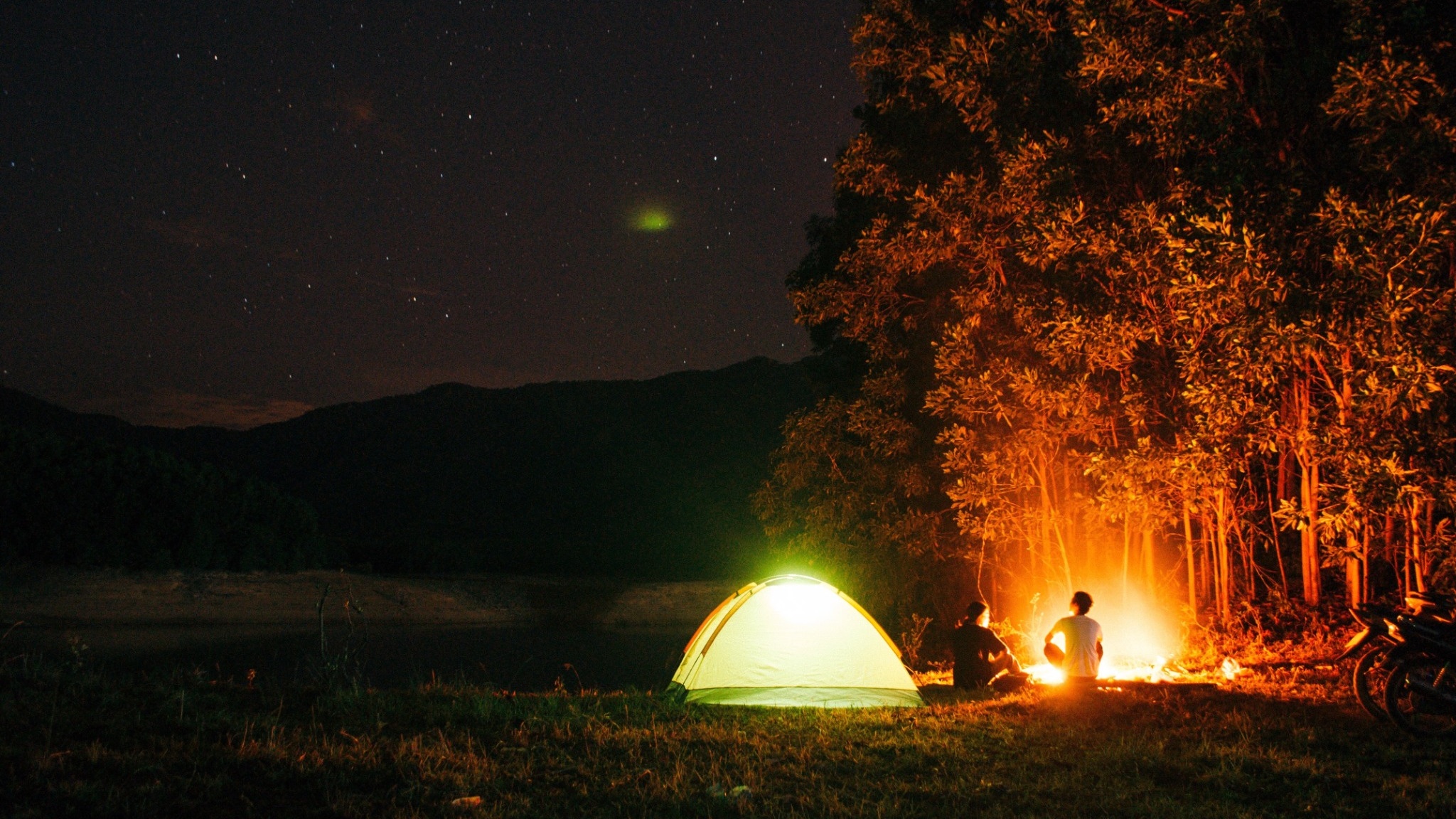
If you can, pick a slightly higher spot with some airflow. REI’s advice may seem backwards at first: choose a spot under the trees rather than an open meadow, because the air under a tree canopy stays warmer at night and your flysheet doesn’t cool down as much. The two don’t actually contradict each other. What you want to avoid isn’t trees, it’s dense vegetation that cuts off airflow completely and keeps the ground permanently damp.
Of course, pitching right on the lakeshore and waking up to the view sounds far more tempting. Who wouldn’t want that? It’s a perfectly fair trade to make, as long as you know you’ll wake up to more moisture in return. Camping is something you learn partly by trial and error anyway, and once you’ve pitched in a few different spots, you’ll quickly notice the difference.
Don’t pile wet clothes into the tent
Another common mistake is bringing wet clothes and kit into the tent at night. The thinking is easy to understand (“I’ll put it inside so it dries”), but in a closed tent that water has nowhere to go. It just moves: out of your clothes and onto the tent ceiling, where it collects as droplets.
If you can, keep them in the porch or somewhere suitable outside that’s sheltered from the rain. In small tents especially, even a few wet clothes noticeably raise the moisture inside; in a two-person tent the space is already small, so the humidity climbs much faster.
Keep your sleeping bag away from the tent walls
A sleeping bag or mat pressed against the side of the tent overnight is another common reason for waking up wet. The water that forms on the inside of the flysheet normally runs down to the ground, but if the inner tent touches the flysheet, that moisture passes from fabric to fabric and goes straight into your sleeping bag.
In small tents this isn’t always easy, because you’re already leaning against the side just to fit. The most practical thing you can do is pull your sleeping bag in a few centimetres and put bulky items such as your backpack between the wall and the bag as a buffer.
Can you stop condensation in a tent completely?
Usually not. If the air is very humid, the temperature drops sharply at night or there’s more than one person in the tent, some moisture will still build up despite good ventilation. That isn’t a pitching mistake, it’s just physics doing its job. The aim isn’t to get rid of condensation entirely anyway; it’s to keep it at a level that won’t soak your kit by the time you wake up.
When you combine good ventilation, a properly pitched tent and a well-chosen spot, the difference really is big. Even so, sometimes you’ll do everything right and still find a few drops in the morning. That’s one of camping’s little surprises.
What to do if your tent is wet in the morning
If the weather allows, don’t pack the tent away straight away. Let it air for a while, open up the flysheet and, if possible, wait for it to dry in the sun or the wind. Fifteen minutes is enough on most mornings.
If you have no choice but to pack it wet, that’s not a big problem at first, but make sure you set the tent up again and dry it completely when you reach your next camp or get home. Leaving a tent damp in its bag for a long time means a bad smell and mould, and over time mould also eats away at the waterproof coating. That’s exactly why the kit maintenance and storage round-up at the end of the season matters.
The bottom line: condensation in a tent is normal
Finding water droplets inside your tent in the morning doesn’t always mean it has let water in; on cool, humid nights, condensation in the tent is a perfectly normal result. Leave the vents open, pitch the flysheet properly taut, don’t pile wet kit inside, and when you choose a pitch, stay a little away from very damp spots.
Do this and, even if the moisture doesn’t disappear completely, you’ll see far less of that “why is the tent soaking wet?” scene in the morning. On hot summer nights the problem flips, and keeping the heat down inside your tent becomes the priority; the fix for both comes down to the same thing: airflow. You can also browse our other outdoor guide articles on camping and pitching.