
Ski Slope Colours Explained: Green, Blue, Red and Black Runs
You open a ski map and find a mountain covered in colours you don’t recognise. Those blue, red and black lines aren’t there to brighten up the page: ski slope colours indicate the difficulty of marked runs. And if a friend says, “Come on, we can get down that,” don’t let that be your entire decision-making process. Your friendship might be solid, but a little actual information is more useful here.
The confusing part? They don’t mean exactly the same thing in every country. Yes, you’d expect the same colour to mean the same thing wherever you go. And just because a run is blue doesn’t mean it will be an easy descent for everyone that day. Knowing the colours is a start; you also need to work out whether that run suits your ability and the conditions on the mountain.
Ski slope colours at a glance
Many European resorts use blue, red and black ratings. Some countries, including France, also use green for the easiest runs.
| Slope colour | General meaning | What to expect |
|---|---|---|
| Green | Very easy / beginner | Usually gentler slopes suited to practising basic skills |
| Blue | Easy | A more manageable descent, with sections that still require turns and speed control |
| Red | More difficult / intermediate to advanced | Steeper or narrower sections that demand more control |
| Black | Difficult / advanced | Steep or technical sections that can be particularly challenging depending on conditions |
This table gives you a general idea. The trail map legend at the resort you’re visiting is what you should check. Especially when skiing abroad, don’t assume a familiar colour means a familiar level of difficulty.
Green runs: A place for your first turns
At resorts that use this colour, green runs are the easiest category. They provide a more suitable setting for getting used to your skis, making slow turns and learning to stop. A resort without green runs can still have suitable areas for beginners; learning areas may be marked with separate symbols on the map.
But don’t read “green” as “I can go up there without knowing anything.” If you’ve never worn skis before, a beginner learning area and a long green run aren’t the same thing. For your first lesson, start in the area your instructor chooses. Learn to stop where you want to first. You’ll have plenty of time for the views. Skiing isn’t just about whether you fall over and get back up, either: if you lose control, you could collide with someone else. Especially when you’re starting out, think about the people around you as well as your own safety.
Blue runs: Easy, but no autopilot
At many European resorts, blue means easy. You may find gentler gradients and more room to turn. Still, don’t assume the entire run will have the same slope or width. A short steeper section, a narrow connecting trail or an icy patch can change the feel of the descent. Unfortunately, saying “It was blue on the map” won’t shorten your stopping distance.
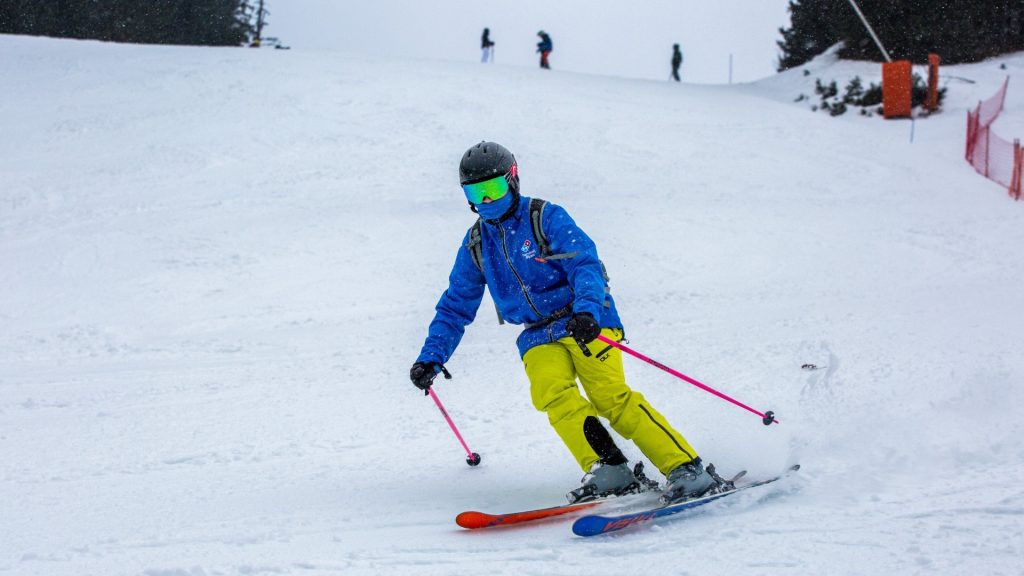
Of course, getting down safely matters. But if you can manage your speed through your turns, turn both ways in control and stop in a suitable spot, you can also use that run to build your skills. On your next descent, pay attention to how you get down, rather than just reaching the bottom.
Red runs: Descents that ask for more control
Red runs require more technique than the easier categories. Definitions vary between countries and resorts, but you may encounter steeper slopes, narrower sections or a route with changing gradients. Your speed can build more quickly here. Being able to link your turns and manage your speed throughout the descent becomes more important.
Getting down a blue run once without falling doesn’t automatically mean you’re ready for a red. Were you in control, or did you reach the bottom thinking, “Well, at least I survived that”? Those are two different experiences.
Black runs: Advanced terrain, not off-piste
Black runs are in the difficult category. You may come across steep sections, bumps, narrow passages or snow conditions that make skiing harder. Not every black run is difficult for the same reason. On one, the gradient may be the main challenge. On another, it might be the bumps or a narrow section. A black rating doesn’t necessarily mean the run is ungroomed, either.
A black run and off-piste terrain are different things. Black is a difficulty rating for a marked run. Once you head off-piste, there are other risks to consider. We’ll come back to those later.
Are the colours the same in Europe and North America?
France commonly uses green, blue, red and black, while Austria’s main categories are blue, red and black. In North America, colours are paired with shapes:
| Symbol | General meaning |
|---|---|
| Green circle | Easiest category |
| Blue square | Intermediate / more difficult |
| Black diamond | Advanced / very difficult |
| Double black diamond | Runs within the most difficult category that require extra caution |
If you usually ski in Europe and find yourself heading to North America, keep this difference in mind. Don’t treat a European blue run and a North American blue square as exact equivalents. Nor can you calculate a double black diamond as “twice as difficult as a European black.”
The US National Ski Areas Association also points out that difficulty ratings aren’t directly comparable between resorts. A colour you ski comfortably at one mountain might challenge you at another. When you visit somewhere new, take a look at the map legend.
Ski slope colours in Türkiye: The Erciyes example
The most reliable way to understand the markings at Turkish resorts is to check each resort’s official trail map. We can’t take one resort’s system and assume it applies across the country. Erciyes lists the following categories in its official slope information:
- Blue: Easy
- Red: Moderately difficult
- Black: Difficult
The resort’s slope table lists run numbers alongside their difficulty ratings. When checking the map, look beyond the lift you plan to take. Make sure you know which runs you can use to get back down. Going up is the easy part; finding a suitable descent is what matters.
There’s one detail that could catch you out: Difficulty colours and open/closed status colours serve different purposes. On the Erciyes slope and lift status display, green means open and red means closed. A green status indicator doesn’t mean the run is suitable for beginners. If you’re still deciding where to go, have a look at our guide to ski resorts in Türkiye. Once you’ve chosen a resort, check its official map and the daily slope status as well.
What slope angles do the colours correspond to?
You’ll find plenty of tables online claiming to answer this. The problem is that some mix up the criteria used in different countries, while others confuse percentage gradients with degrees. A 25% gradient and a 25-degree slope are not the same thing. There also isn’t one universal table of slope angles that applies to every green, blue, red and black run.
So don’t turn choosing a run into an exercise in memorising numbers. Consider the resort’s rating, the layout of the run and the day’s conditions together. A narrow connection or a short steep section can make an easy-looking route more challenging. What looks comfortable on paper can feel rather different at the top.
Which run should you choose on your first day?
If you’re skiing for the first time, start in the learning area your instructor recommends. The run your friends have been skiing for years doesn’t have to be suitable for you. If you’ve skied before but taken a long break, don’t jump straight back in where you left off. Make your first descent an easy one where you can check how you’re feeling. How are your turns, speed control and balance? Find out first.
Before getting on a lift, know the answer to this question: “Which route down from the top suits my ability?” If you can’t work it out from the map, ask a member of staff or an instructor. Starting to think about it after you’ve got off the lift could be a little late.
If you’re deciding between skiing and snowboarding, our skiing or snowboarding guide explains how the beginner experiences differ. The slope markings apply to both; the techniques are different.
When should you move from blue to red runs?
We can’t say “on your second day” or “once you’ve had five lessons.” People learn at different speeds. Instead of counting days, look at what you can comfortably do on an easy run:
- Can you turn both ways while staying in control?
- Can you link your turns to manage your speed?
- Can you stop safely in a suitable spot you’ve chosen?
- Can you do these things consistently on later runs, rather than just once?
Answering yes to all of them doesn’t mean you’re ready for every red run. Ask your instructor which one would suit your first attempt. Runs can share a colour without having the same layout.
And don’t save this step for the end of the day. If your legs have started shaking, “Let’s try a red as well” might not be your best idea. The harder run will still be there another day. If you’d like to get a little fitter before the season, take a look at our ski season preparation guide.
Why does a blue run sometimes feel difficult?
The blue run you skied comfortably in the morning might give you a harder time in the afternoon. It’s the same run, but the snow and how you’re feeling have changed.
- Ice: On hard, slippery snow, getting your ski edges to grip, turning and controlling your speed can become more difficult.
- Fog and flat light: Fog reduces visibility. In flat light, fewer shadows and less contrast make bumps, dips and changes in gradient harder to see.
- Changing snow: Softening snow or piles of pushed-up snow can feel different from the surface you got used to that morning.
- Crowds: You may have less space to turn and need to pay closer attention to the people around you.
- Fatigue: Turns that felt comfortable in the morning may not come as easily once your legs are tired.
Don’t insist on continuing just because “I skied it this morning and it was fine.” If the conditions have become more difficult, switch to an easier run or take a break. You don’t have to squeeze in every descent on your ski holiday.
How should you read off-piste and closed-run signs?
Don’t think of off-piste skiing as the next step after black runs. Outside marked runs, you may encounter avalanche risk, obstacles hidden beneath the snow and unfamiliar terrain. That calls for additional knowledge, training and preparation. Being a good piste skier isn’t enough on its own.
Maps may use different colours, dashed lines or symbols for ski routes and ungroomed terrain. Check what they mean in the map legend. A symbol you’ve seen somewhere else might not mean the same thing here.
With a closed run, the question isn’t how well you ski. If there’s a closure sign, barrier or an instruction from resort staff, don’t enter. You may not be able to see the reason for the closure from where you’re standing.
If your friend is still saying, “Come on, we can get down that,” open the map together. Make sure you know which run you’re taking. That way, nobody has to announce halfway down the mountain, “I don’t remember it being like this.”